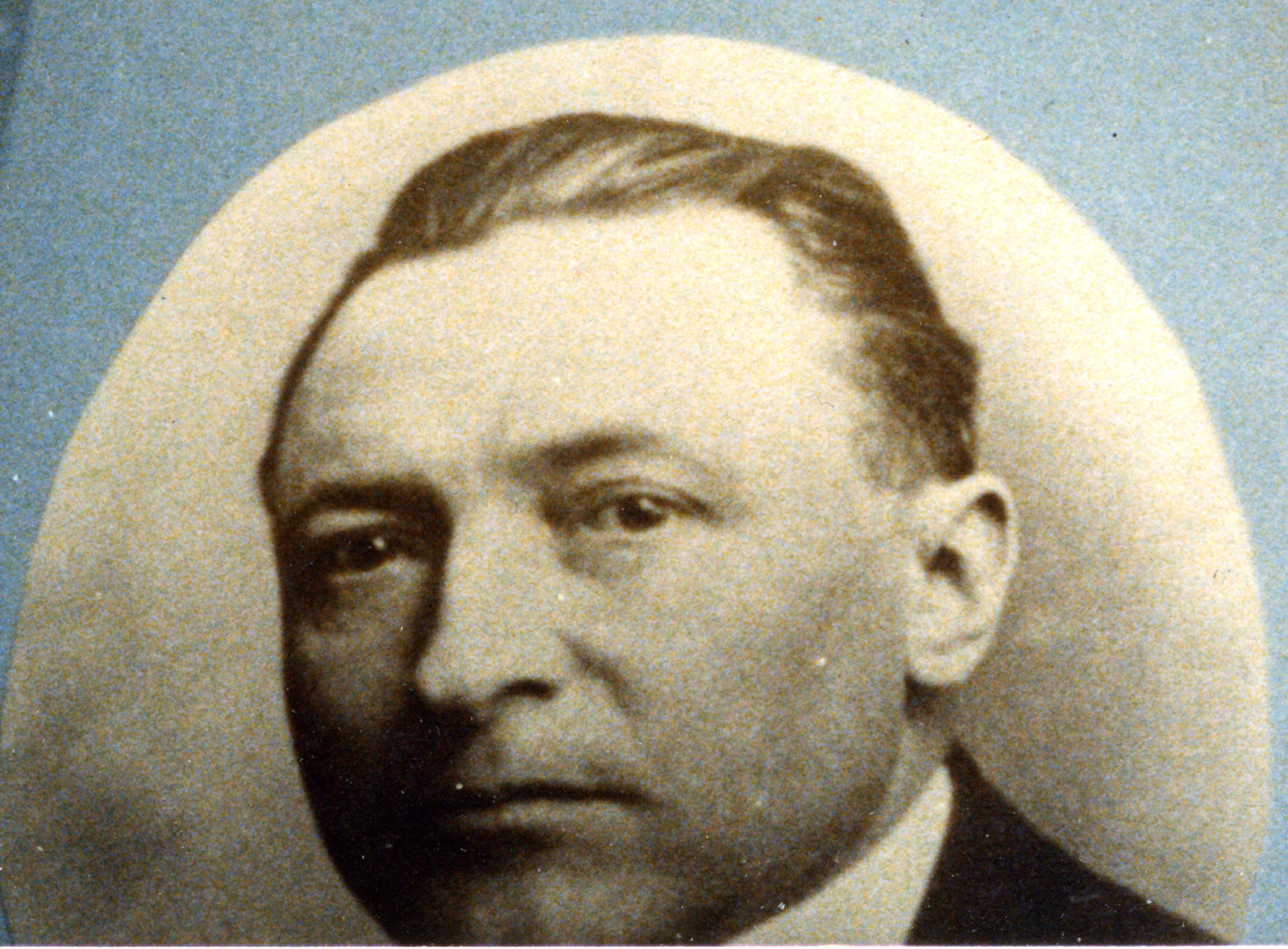

Gaston Borch (1871-1926)
Borch (the "ch" is pronounced "k," as in "Bork") was a prolific composer of photoplay music from about 1916 until his death, and also wrote standard classical works including at least one opera (Silvio, produced in Oslo in 1897 and Christiania in 1898). Some of his photoplay music pieces appear to be adapted from larger works -- perhaps other operas or ballets -- though I have been unable to substantiate this. His style ranges widely, from the achingly beautiful melodies of his Dramatic Tensions and Pathetic Andantes, through the Grieg-like folk qualities of his Mountain Music Suite and "Norwegian Folk Song," and the bizarre orientalism of his American Indian and "Oriental" film pieces, so crucial to our scores for such films as The Silent Enemy, The Thief of Bagdad, and Destiny.
His guide book, Practical Manual of Instrumentation (1918) is an interesting window into the orchestras and orchestration techniques of the era, comparing the instrumentation of American and European theater orchestras, and describing methods of "cross-cueing" pieces so that the same arrangement can be used by groups ranging from piano trios up to large orchestras.
I have been gathering what information I can about Gaston Borch from disparate sources, and these are thrown together below.
This is an article submitted to the Massenet Newsletter, published by the American Jules Massenet Society, Jan 1, 1982, by F. Gerald Borch
FAMOUS PUPILS OF MASSENET
Gaston Borch
The appellation "famous" may not be entirely appropriate for me to use, since I am writing about my own family, but since the previous profiles have carried this title, I will continue the precedent and ask the reader to make the determination as to the propriety of the usage .
My grandfather was born in Bologne s/Mer (France) in March 1871 of a Norwegian father and a French mother. Most of his boyhood was spent in Sweden with academic studies at the French School and musical studies at the Royal Musical Academy in Stockholm. As the eldest son of a prosperous father who was extensively involved in the mining business, it was naturally expected that he would eventually step into and run the family business.
However, at the age of twenty-two, following the completition of his commercial and academic studies, he decided to make music his profession and promptly set off for Paris. This turn of events was probably not too shocking to a very indulgent family because although his father was an astute and successful business man, Gaston belonged to a family significantly involved in Norwegian politics and the arts. Gaston's uncle, Christopher Borch was a prominent Norwegian sculptor (his large granite lions gracing the entrance to the parliament buildings in Oslo). Emma Louise Hennequin, his mother, had been a student at the Paris Conservatory, together with her brother. She was a very accomplished singer, and a talented artist as well. It was she who came to know Massenet intimately, having been engaged to him prior to his being awarded the Prix de Roma in 1864. It no doubt was her influence and close friendship with Jules Massenet (which they continued until her death in 1899) that was the impetus for my grandfather becoming a private pupil of the great master outside of the conservatory classroom. He studied composition for three years with Massenet and while there he continued his cello studies with Barraine and Joseph Hollmann. He achieved a considerable technical proficiency on the cello which allowed him to concertize to some degree and this ability provided him with employment in American symphony orchestras.
Although the Borchs considered their brother quite a Bohemian, still he must have been very busy during those Parisian years. In addition to his concentrated study with Massenet, and diligently pursuing his cello studies, he was studying conducting with Charles Lamoureux as well. Following these three years, before his return to Scandinavia, he stopped in Copenhagen for further piano work with Arthur DeGree (actually in Brussels) and conducting with Johan Svendsen. Upon returning to Norway, he was engaged by the Oslo (Christiana) Philharmonic Society and conducted there from about 1897 to 1899. It was during this period of time that his one act opera ''Silvio" (a sequal to Mascagni' s "Cavalleria Rusticana") was performed at the Eldorado Theatre in Oslo, and successfully acclaimed.
During this Norwegian period, he also managed to regularly conduct the Bergen Musikforengingen and to direct the activities of the Bergen Conservatory of Music. And in Bergen he continued his studies in composition with Grieg. In 1897 Grieg wrote of him, recommending him as "one of the best chefs d'orchestra, and most promising composers of our time."
We commence his American period when in 1899 he went to the United States where his uncle Dr. Alfred Hennequin, a playwright, was living in Boston. Gaston was engaged by the Chicago Symphony as a cellist. He served there about one year and at that time, Victor Herbert was conducting. It may have been Herbert who encouraged him to leave Chicago for Pittsburgh because from 1903 to 1906, he was with the Pittsburgh Symphony, the conductors at that time being Victor Herbert and Emil Paur. A compatibility with Herbert existed because of their common interest in the cello, and apparently my grandfather's abilities were admired and recognized. In this connection, there is a long adhered to family story telling that my father, who could not have been more than four years old, conducted the Pittsburgh Symphony in the "Star Spangled Banner while being held in the arms of Victor Herbert.
It was while my grandfather was with the Pittsburgh that Emil Paur arranged for the premier U.S. performance in 1906 of his overture "Genevieve de Paris," which had been written in 1904, had been performed in Europe, and had been dedicated to Massenet. The Master had predicted a brilliant future for Gaston to his friend Emma Hennequin Borch and assured her that he was headed for the top as a composer and conductor. Massenet was known for being excessively effusive and flattering, and possibly he was guilty of these things in his estimation of my grandfather's future prospects.
During the orchestral off seasons, Gaston Borch toured France, Belgium, Holland, consistently conducting and performing his own compositions. He consistently conducted the Lausanne Symphony and had guest appearances with the Amsterdam Concertgebow, Opera of Brussells, Societe Symphonique of Lille (France), Harmonie Royal of Antwerp, Gewerbehaus Orchestra (Dresden) and many others. As a result of these invitations, he became far better known abroad as a conductor and composer than was the case in the United States. There were however, performances of his works in Pittsburgh, Philadelphia, and by the Minneapolis, Montreal and Cincinnati Symphony Orchestras. In 1907 he conducted in New York at Carnegie Hall, the Grieg Jubilee Concert. Gaston Borch became very prolific as a composer having nearly 200 songs for voice, choral and instrumental works published. He turned to arranging as well and was well-known for his orchestral arrangements and transcriptions for cello. There were and are many of his works still carried in the G. Schirmer, Carl Fischer and Boston Music Company catalogues. In 1918 his "Practical Manual of . Instrumentation" was published by the Boston Music Company.
He became exceptionally well-known in the U.S. and abroad for compositions done especially for the silent film industry. This occupied his final six or seven years of his life (he died in 1926). The Museum of Modern Art in New York issued a recording a few years ago called "Mood Music for the Silent Film" on which they included three of his compositions, all of which were very recognizable to the individual who sat through the silent film era. His greatest achievement in this area was probably the score (written in 1924 after his return to Sweden in about 1921 and his great involvement. with the film industry there) was his orchestral score done for the Greta Garbo movie "Gosta Berlings Saga". He conducted an orchestra of 26 when the movie had its premiere and ran during that time at the Skandia Theatre in Stockholm. In the 1950s, the movie had a revival and the musical score was again used.
Gaston Borch produced a number of tone poems, a fairy opera "Ostenfor Sol" and "Frithiof," the latter based on a well-known Scandinavia saga, a piano concerto, at least one symphony and a very succesful work "Quo Vadis" which was performed for the first time in Philadelphia in 1909. In 1964, his tone poem "Vita et Mors" was again performed by the Gothenburg Radio (Sweden) having been earlier performed by the Stockholm Symphony and the Montreal Symphony in 1920. There are at least two compositions for violin and piano, the more important being "Romanza" and "Elegy".
F. Gerald Borch
Charlotte, North Carolina
From Michael Christopher Borch, email on 1/6/2012.
My name is Michael Christopher Borch I am the grandson of Gaston Borch. For the heck of it I was checking up on the computer as to what new info regarding my grandfather was available. I see that you have been putting his music to great use, thank you. My father (Ragnvald Christopher Borch) often remembered as a little boy his father seated in the living room ( W 56th Street NY) with his cello writing music and having visitors stop by. Victor Herbert was a frequent visitor so he said. My father was born in 1910 and in 1917 Gaston was forced to flee the United States after conducting the Boston Symphony Orch on grounds of bigamy. My grandmother ( Eleanor Svendsen) had no idea he had been married before and had a child. She had my father and his two sisters. From what I understand Gaston was a real character. My father always claimed that Gaston wrote the famous score you here in the silent films ( he called it Mysterioso Music) that famous short burst of (dee dee dee dee.D... dah dah dah dah) I'm no musician. Is this possible? Also my father used to say that Gaston may have been the illitgitimate son of Jules Massent as Emma supposedly were romantically connected. Gaston was a student of Massanet and took great lengths to educate him in music. He had nothing to do with the Borch shipping business in Drammen Norway.... he just played music and his sister Frieda was a very good friend of Rachmanoff. Other than that he was not well remembered and few kind words were ever spoken about him. Well thank you for keeping his music alive.
From a second email, on 1/6/2012, slightly corrected for typos.
Dear Rodney:
I was so glad to hear about your interest in Gaston Borch. Thank you so much for contacting me. I will try to fill you in with as much as I know from a historical perspective.
I do have a photo of my grandfather with my father taken in 1917 in Pennsylvannia? Supposedly he suffered from very bad asthma and he found relief in the Poconos. I will send you this picture. It shows him with my father around age 7 or 8 and "jack" the singing dog. My aunt said every time papa would play the cello the dog started to sing... lol probably tortured the poor dog.
My father was very saddened by what happened in 1917. My grandmother recieved a telegram from a lawyer in california stating Gaston was married and had a child ( Rose: wife and Fred Borch: son) she was suing for divorce on grounds of desertion. The only time I ever saw my father tear up and he was a decorated WWII veteran was relating the story of that day. He watched out the window with his younger sister and Gaston was coming home as usual with cakes and things. My Grandmother speaking no english (only Norwegian) started to scream at him at the door "How can you do this to us?" he did an about face and walked away. My father didn't see him for almost a year.
My grandmother was forced to leave the apartment on w 56th street and go stay with relatives in Brooklyn then on to Tannersville, Pa where she opened a boarding house. This is where Gaston liked to go to get relief from his Asthma. So for some reason they settled there. My father had two sisters Daghney and Louise ( Aunt Raga) Gaston named her rag doll. lol. Aunt Raga was exceptional organist never taking formal lessons yet could read and write music and play anything by ear. She died in 1984. My father was good at violin and also made violins. He passed away in 1968 ( I was 11) I'm 54. My other aunt Daghney was the youngest school teacher ever in the State of Pa. She passed away around 1990?
Through the years I made contact with (My half cousin) grandson from first marriage. He was Gerald Borch from Charlotte NC. I believe he has since passed on. He filled me in on a lot of Gaston's antics. The cello was talked about but he supposedly was looking for rights to music etc. back in the 1950's but Gaston's third wife told him to basically "take a hike" as there was nothing. He did tell me that Gaston was buried in Stockholm and that since the cemetery did not have perpetual care it was bulldozed over to make room for apartments.
My grandmother was very bitter about the whole thing and was forced to stay in this country. She did recieve help at times my father said by Gaston's brother Harold? a Norwegian seaman who visited often but his family would never recognize the existance of his American families. I understand they were very well off in Norway.
Cousin Gerald showed me a 1849 photo of my Great-great grandfather ( Anton Fredrick Borch) taken at Calais France. I understand that the family shipped wood from Norway to Antwerp, Begium and brought coal back to Norway. From what I heard Gaston's Father was a big drunk and very crude... and accused his wife of having an affair with Massanet. But from family history it seems like they bankrolled Gaston all the time.
I remember in about 1966 my father meeting with this very very old man in Florida regarding his father ( supposedly he was the last man to see him in the US) he was a big shot with Schirmer Music? (I don't know if this is correct) Anyway he told my father Gaston was a " big bs artist" my father laughed it off and more or less figured it out. He recalled constant fights over money and endless arguments in Norwegian between his mother and father.
He always spoke about the beautiful sunday dinners at the Waldorf Astoria that his father would take them too. Also as a boy when I watched the famous March of the Wooden Soldiers ( Laurel and Hardy) my father wold tell me " I heard this long before it ever was in the movies." As I said Victor Herbert was a frequent visitor to the house. Supposedly my grandmother didn''t like him?? my aunt would say Mamma said he was another one full of himself... It must have been something in those days.
Supposedly Gaston was fluent in English, French, Norwegian, German., Italian, Russian. My father was fluent in Norwegian, German and italian and during WWII interrogated prisoners as a member of US Military Police and was present at the execution of Germans during the Battle of the Buldge after having interrogated them.
....
I'm so happy that you are keeping his memory alive in music. I would love to see a performance. Hopefully maybe I can get to Colorado. I've only flown over it numerous times. lol again, thank you so much and I hope I was not long winded with this disertation of the great GASTON BORCH! We could say he lived like a rock star.. for those days anyway.. Thank you
Julie Brown brought to my attention this review, from the September 22, 1921 issue of the Kinematograph Weekly, by Gilbert Stevens. This is a review of Gaston Borch's presentation of a film score at the Alhambra Theatre in England.
"The Old Nest": The Music.
It would be unfair to pass judgment upon the musical setting to this Goldwyn picture from the performance at the first night. On this occasion Gaston Borch, the musical director, was working under somewhat of a handicap. The rehearsals had obviously been not very numerous, and the orchestra was very much depleted and not nearly strong enough to do justice to some of the numbers, the majority of which were the musical director's own composition.
A second audition left a much more favourable impression. The execution was much better and the breaks between the numbers not so noticeable. At the same time I do not think that the musical setting is an ideal one. The various numbers in themselves are excellent, but in my opinion Mr. Borch has made the musical setting too sad. The pathos of the picture is great; that of the music is greater, and consequently the music rather tends to dominate the picture.
"The Old Nest" is not an easy film to which to set music. One has to be very cautious lest the sadness of the whole thing be over-emphasised by the music. At the same time I can find no excuse for the introduction of "effects" into the setting. We see the engine of a fast-moving train on the screen; the whistle is blown, as is obvious from the steam seen issuing from the valve. What need is there, then, to emphasise the obvious by making a noise like an anemic steam whistle in the orchestra? This kind of thing is associated with the penny side-shows twenty years ago, when kinematography was as great a curiosity as the fat man, and considered by most to be quite as vulgar. It certainly does not become a musical director of Gaston Borch's reputation to resort to cheapness of this kind.
Another weakness in the setting is the use of "My Old Kentucky Home." I know Mr. Borch will disagree with me on this point, as may some of my readers. But I cannot see that the introduction of popular music—especially "sob" stuff—into the setting does ought but harm to the picture. In this particular instance I can prove it. When "My Old Kentucky Home" was started, a man sitting immediately behind me started a conversation with his partner about what happened when he last heard this tune. The talk lasted for some moments (much to my annoyance), during which it was obviously impossible for the speakers to follow what was happening on the screen.
Nothing is more detrimental to a picture than the introduction of popular music into the musical setting—unless, of course, the number is a humorous one which may happen to fit a certain scene in a comedy. Every such tune carries its own associations in the mind of the picturegoer, and causes attention to be distracted from the picture. There is plenty of original music to fit such scenes as were accompanied by these over-worked tunes.
Some of the Numbers.
In the choice of the theme the musical director has been happy. It is an excerpt from his own composition, :Andante Symphonique," and adequately interprets the predominant emotion running throughout the picture. The "Andante Doloroso" by the same composer is another excellent number which musical directors might well use in scenes of the most poignant grief. I was pleased to hear Grieg's "French Serenade," "Folk Song," and "Butterfly," while Friul's "Legende" was very welcome, although the execution left much to be desired. Other numbers in the program are "Butterfly Dance," "Feuilles Mortes," "Shadows in the Night," "Passion," "Purity," "Lullabye," "Capricious Anette," Misterioso, Dramatic Andante No. 24, Andante Pathetique (all by Gaston Borch); "Symphonette No. 1 (Berge), "Overture Mureille (Gounod), "Cantilena" (Parioli), "Les Trissono" (Leble), "Romance" (Dumas), and "Au Moulin Rouge" (Thela). All these numbers may be obtained from Winthrop Rogers And Co., Berners Street.
About the Composer.
Gaston Borch has had much experience as kinema musical director, principally in the United States, where he was responsible for the music at the Plaza Theatre in New York. He says that in this house he was allowed a perfectly free hand with the music, with the result that the Plaza became famous as the kinema where one heard the best music. His principal work, however, has been conducting for operas, which he believes has helped him a whole lot in kinema work, for it has developed his sense of the dramatic, without which no kinema musical director can hope for success.
Mr. Borch has composed a great deal of music, including about one hundred and fifty pieces for orchestra written especially for the screen; two symphonies, four symphonic poems (the latest, "Quo Vadis," is now being played in Germany and Scandinavia with great success); four grand orchestral suites (the latest of which, "Mohikana," is now on the press); two oratorios, "Easter Tide" and "Yule Tide," and some thirty or forty smaller church compositions.
In an attempt to keep up with Gaston's complicated life, I've entered a bunch of data below in roughly chronological order. These facts are gleaned from the internet, census records, and scanned newspaper articles. Square brackets indicate sources.
1893-1899 conductor of the Christiana Orchestral Society - Norway and the Musikforeningen - Norway [stokowski.org]. This date may be a year too long based on the info below.
1894-1896 visiting conductor in France, Belgium, Holland and Germany [The art of Music]
1898 Emigrated to US
1899-1900 playing cello and conducting Theodor Thomas' orchestra in Chicago (which was renowned for playing new and challenging music).
On 24 June 1900, a newspaper says that Gaston has been just lately married to Gyda Hennig, who is presented as a Norwegian pianist.
On 1 July 1900 the St Paul Globe announced an upcoming concert on 19 July. Both Gaston Borch and Mrs. Gaston Borch, Rose Alice Gluckauf performed. It's revealed that Rose performed under the stage name Miss Gyda Henning (sic). She had studied piano and voice in Europe. Mr. Borch has made his home in Chicago this winter and has become famous as a conductor and cello soloist. He also conducts the symphony orchestra that is giving weekly concerts at the Auditorium.
On 5 July 1900, he married Rose Alice Gluckauf in St. Paul Minnesota. (Rose's last name gets butchered in various historical documents, as Genuk, Gluckauf, Glickauf, Glickhauf).
There are several concerts through the weekend July 6-8, 1900, as a Scandinavian music festival. Both Mr. and Mrs. Gaston Borch performed. St Paul Globe: "Professor Gaston Borch of Chicago contributed a cello solo in his usual artistic manner."
On 22 April 1901, Borch submitted a patent application for a piano attachment. At that time, he lived in 924 1/2 East Second Street, Duluth, Minnesota. This was announced, as the Sonorite Piano Attachment, d on 13 October 1901 in a St Paul paper. (The attachment was a set of metal fins attached to the back of an upright piano to make it project sound better.)
On 10 October 1901, he performed in Syracuse New York. The paper says he arrived after living in Duluth for two years.
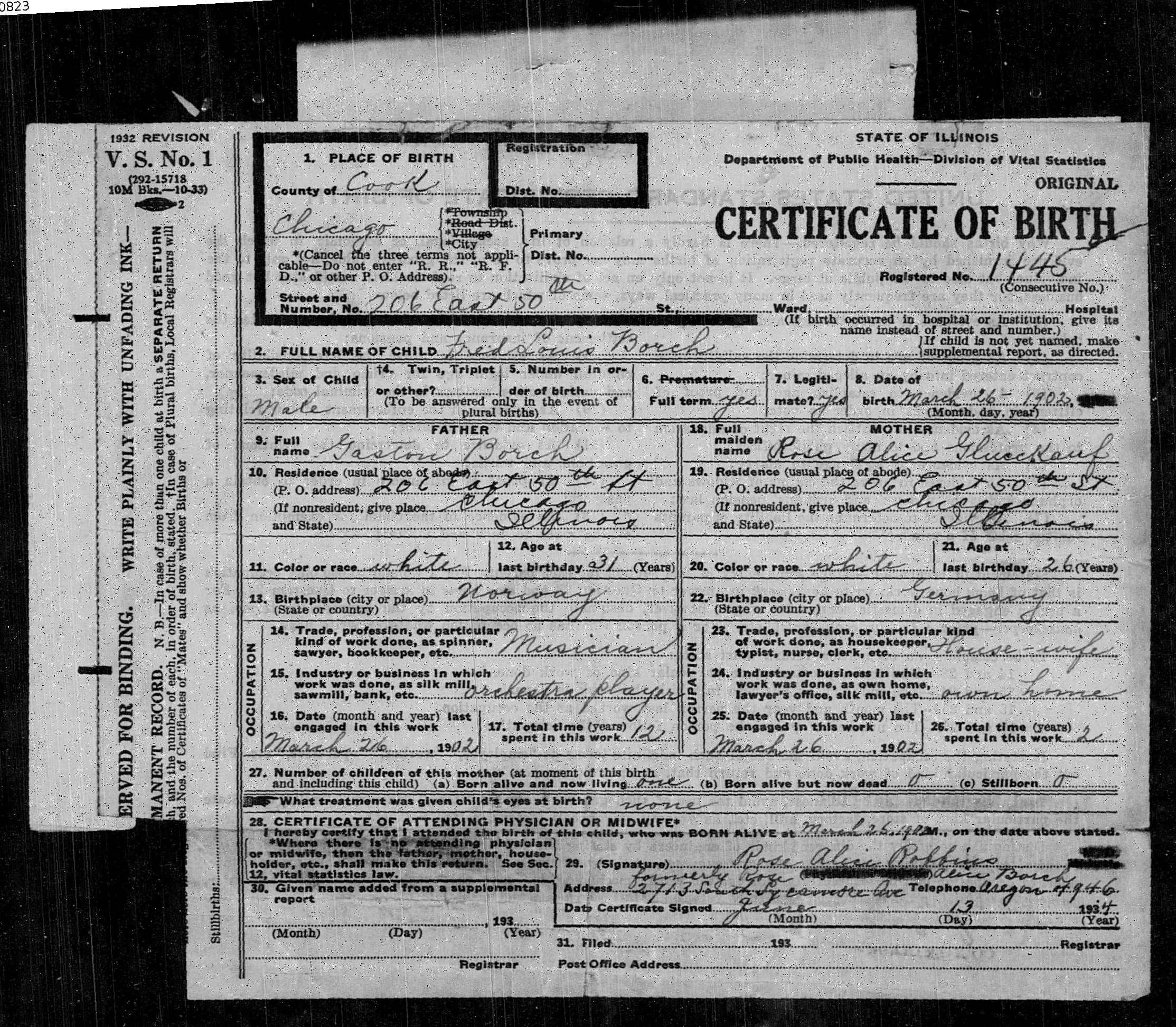
26 March 1902 Gaston and Rose had a son, Frederick Louis Borch. Born in Chicago. Mother's maiden name on the birth certificate is, as expected, Rose Alice Glueckauf. But the Certificate of Attending Physician or Midwife are filled out, perplexingly, as "Rose Alice Robbins, formerly Rose Alice Borch." Is this also Rose Alice Gluckauf, attending midwife at her own delivery? If so, why the new last name?
16 May and 18 October 1902 show Gaston Borch as professor of cello at Syracuse University.
From 1903-1906 he played cello in the Pittsburgh Symphony Orchestra under Victor Herbert (along with future photoplay music composer J.S. Zamecnik, who was in the second violins). The site Stokowski.com has him as principal cello.
He then returned to Europe as a conductor in Lausanne, Switzerland; and served as a guest conductor throughout Europe.
On 30 October 1905, the New York Passenger Arrival Lists have Gaston arriving from France, but his name is crossed out, and "Not on board" is written in the margin. He actually returns 24 October 1906, according to Ellis Island records.
23 January 1906, "Genoveva," a concert overture by Gaston Borch, was performed by the Pittsburgh Orchestra at a reception of the Art Society in Carnegie Music Hall, Pittsburgh. The composer conducted. [Boston Symphony Orchestra, Volume 37].
1906 Conductor of the Lausanne Symphony Orchestra, Switzerland [The Art of Music biography]
1907? Marries Eleanor M.S. Borch (see 1910 census below). Apparently failed to divorce Rose Alice Borch beforehand.
27 April 1907 Conductor of the Grieg Jubilee Concerts, New York [Chicago Symphony archives]
10 January 1908. Gaston plays at a concert in New York City.
1910 Census. Rose Borch and Frederick Borch are living in Chicago without Gaston, but with Rose's mother and step-father.
1910 Census. Gaston Borch is in Philadelphia, living with Eleanor M.S. Borch, age 30. They have been married three years, one daughter Emma D. Borch, age 1 year 5 months. The note from grandson Michael Christopher Borch indicates that his father, Ragnvald Christopher Borch, was born in 1910, presumably after the census, and that there were two sisters, so that one more daughter was to come.
1910 a member of the faculty of the Pennsylvania College of Music, Philadelphia [Baltzell's dictionary of musicians, 1910]
At some time between 1910 and 1917, he appears to have moved to New York, based on the recollections quoted above from Michael Christopher Borch. The 1921 Kinematograph Weekely says he was musical driector of the Plaza Theatre in NYC, but I have not confirmed this from other sources.
1917 According to Michael Christopher Borch, Eleanor discovered that Gaston had an earlier wife, and throws him out. He goes to Boston.
1920 Census. Rose Borch, daughter, age 40, widowed, and son , age 18, b. IL, parents b. Germany, living in Decatur.
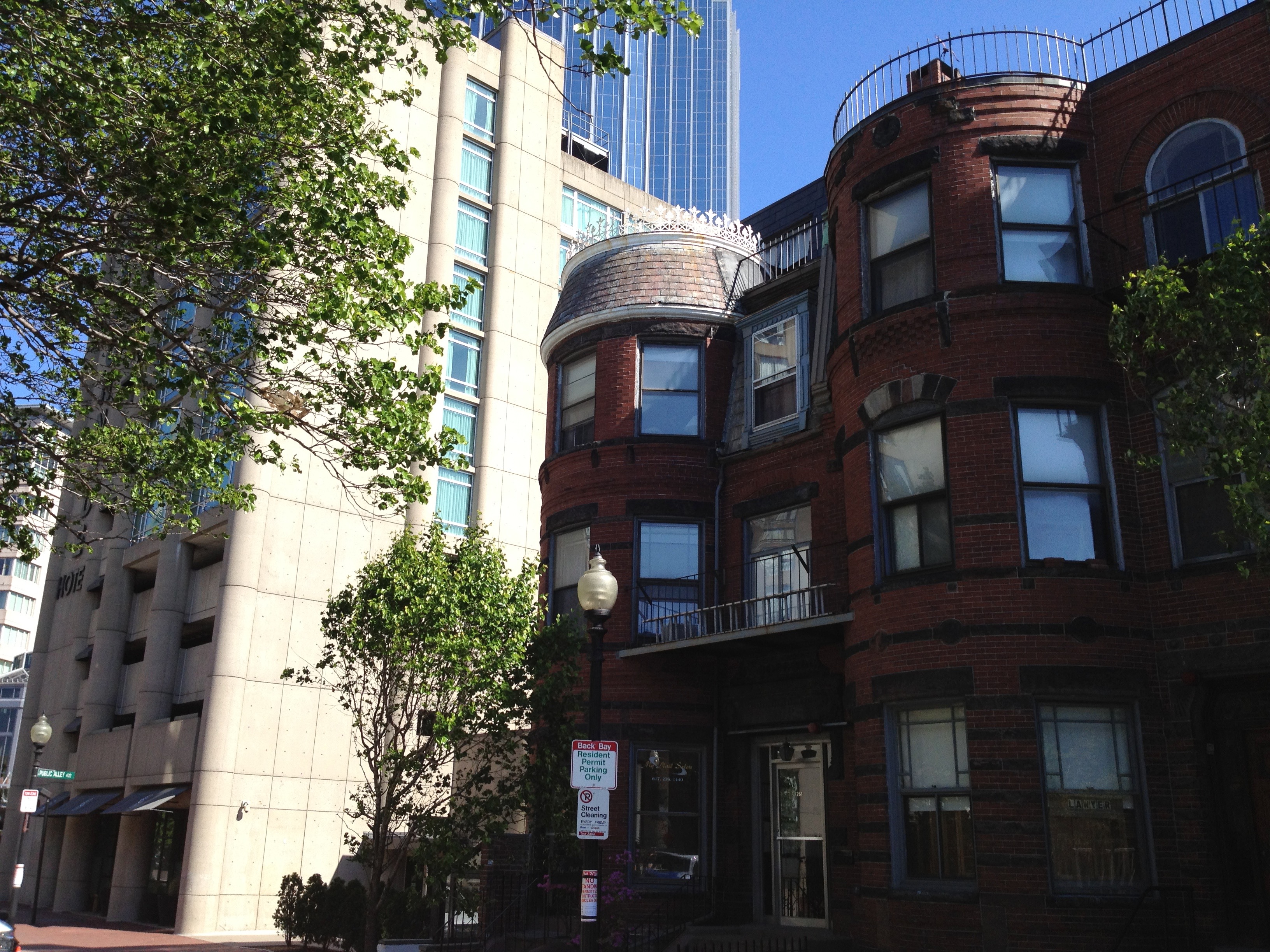
1920 Census. Gaston Borch, age 43, lodging at 261 West Newton Street, Boston; along with Elsie Borch, age 22. Elsie is noted as not speaking English.
Here is what 261 West Newton Street looks like today... it looks to have barely (by one block) escaped the demolition that made way for development of the Prudential Center.
In 1921, Borch appears as the musical director at the Regency Theater in Brighton, England. Julie Brown tells me that Borch quickly disappears from the press, which suggests he did not stay in Brighton for long.
1921. According to Massenet newsletter, Gaston Borch returns to Sweden (possibly to avoid bigamy charges according to Michael Christopher Borch?) where he becomes involved in the film industry. Composes score for film The Saga of Gosta Berling (1924), and conducts it at the Skandia Theater in Stockholm. The score was revived for a screening in 1950, so it may still survive.
22 January 1922, Decatur Review (Illinois) reports Mrs. Rose Borch presenting evidence of bigamy in a divorce case.
1925 "Returned to Sweden where he is said to have made the first orchestral radio broadcast in January, 1925 with the Skandia Cinema Orchestra" [stowkowski.com]
14 February 1926, Gaston Borch dies in Stockholm Sweden. [bardon-music.com]
2 November 1950, Elsie Borch renews copyright to "Amour Deçu," acting as widow, as reported in the Catalog of Copyright Entries.