Click on the title of interest below to be taken to that portion of the list. Or, scroll down to browse through titles, reviews, and purchasing sources for our audio and video recordings. Many links will play musical excerpts of these scores.
Mont Alto has four CD recordings of music from the silent film era.
Each contains over an hour of music originally written in the
teens and twenties for silent film accompaniment. The CDs may
be ordered directly from Mont Alto by printing our order
or from amazon.com through the links provided by each title.
Track Listing:
1. Canzonetta, J. L. Nicodé (4:09)
2. Entreaty, J. S. Zamecnik (3:32)
3. Serenata, Valentina Crespi (3:30)
4. Legend of the Canyon, Charles Wakefield Cadman (3:49)
5. Melancholic Andante, Jacque Pintel (1:56)
6. Romance D’Amour, A. Arensky (2:23)
7. Serenade Lointaine, Irénée Bergé (2:01)
8. Melancolie, E. Nápravnik, (4:13)
9. Confession, J. S. Zamecnik (3:37)
10. October Twilight, Henry Hadley (2:03)
11. Fleurette, Victor Herbert (2:52)
12. Heart o’ Dreams, J. S. Zamecnik (3:55)
13. Serenade Romantique, Gaston Borch (2:34)
14. Lovely Flowers, Gaston Borch (2:42)
15. Pathetic Andante No. 1, Otto Langey (1:35)
16. Serenade, Cecile Chaminade (2:49)
17. At Sunrise, “Desert Suite,” Homer Grunn (2:26)
18. Les Roses d’Ispahan, Gabriel Fauré (2:52)
19. Nydia, J. S. Zamecnik (4:06)
20. A Simple Love Episode, Herbert Haines (3:16)
21. Silent Sorrows, Gaston Borch (2:31)
22. Serenade, A. Rubinstein (5:59)
23. Adieu, J. S. Zamecnik (1:53)
24. Solemn Scenes from Nature, Christopher O’Hare (5:13)
The Mont Alto Motion Picture Orchestra, a five-piece chamber ensemble, revives music composed and arranged for silent movie orchestras. This album features romantic themes from our recorded scores for The Blot, Children of Divorce, College, The Coward, Les Deux Timides, The Fall of Babylon, The Flying Ace, Mothers of Men, The Penalty, Ramona, The Silent Enemy, Timothy’s Quest, and People on Sunday.
Entreaty focuses on romantic music published for silent film scoring. An aptly chosen piece of music can telegraph the difference between innocent love, desperate passion, and doomed romance.
Some of the finest "love theme" cues of the entire silent film repertoire are included on this album, including Entreaty, Heart o' Dreams, and A Simple Love Episode
You can buy Entreaty either as a CD or as a download on our page at CDbaby (which also has samples of the music), or through iTunes or where ever else music is sold. You can also buy it through Paypal by clicking on the button to the left.
Entreaty was chosen as "Album of the Week" by KDFC Classical FM, in San Francisco, for the week of June 11, 2018.
Track Listing:
1. Melodie, Charles Huerter (2:48)
2. Serenade, A. Arensky (1:56)
3. Norwegian Folk-song, Gaston Borch (2:04)
4. A Curious Story, H. Frommel (2:56)
5. Euphonious Agitato, Jacque Pintel (2:30)
6. Yaksha Dance, Irénée Bergé (2:46)
7. Song of Supplication, Percy Fletcher (3:14)
8. Sèrènade, Saint Saëns, (4:14)
9. Poupée Valsante, E. Poldini (3:25)
10. Nettuno, Renzo Viola (2:59)
11. To Mission San Francisco, Lily Strickland (2:20)
12. Indian Wail, Antonin Dvořák (3:47)
13. Silhouettes: III. Italian, Henry Hadley (1:41)
14. Disperazione, Gabriel-Marie (3:28)
15. Lamentoso No. 46, Gaston Borch (3:22)
16. Resignation, Gaston Borch (2:00)
17. Dramatic Recitative No. 2, Sol P. Levy (1:29)
18. Hurry No. 26, M.L. Lake (2:26)
19. In Saint Malo, Christiaan Kriens (5:11)
20. Rendez-Vous, Gaston Borch (2:31)
The cost is $12, plus shipping. To order a copy, click on the Paypal button or visit our purchase by mail order form.
For mp3 downloads of the entire album, visit our page at CDBaby.
Love, Betrayal, and Redemption: Music of the Silent Cinema
The Mont Alto Motion Picture Orchestra, a five-piece chamber ensemble, revives music once played in silent movie theaters. This album contains highlights of Mont Alto's recorded dvd scores for The Italian, Faust, Bardelys the Magnificent, The Last of the Mohicans, Way Down East, and The Italian Straw Hat.
Orchestral silent film scores were pieced together scene by scene from libraries of music maintained by each theater's musical director. These collections contained plenty of works from the classical and salon music repertoire, but movies demand more than just overtures, intermezzos, and waltzes. As demand grew for music more suited to the kinds of scenes seen in typical films, many classically-trained composers considered this a new genre of classical music, and wrote numerous high-quality pieces specifically for silent film orchestras. They had no idea how soon their work would be plunged into oblivion by the coming of sound films. Mont Alto's mission is to explore and revive this lost repertoire for modern audiences.
"...What makes this CD so appealing is not only its period charm, but the sense that these representations of emotion and cinematic action have attained a kind of universality which endures over several generations. This music may evoke the movie-going experience of my grandparents' youth, but it plays on my feelings as expertly as it did theirs, and I'll bet even the hard hearts of Lady Gaga's devotees would feel a few palpitations.
The Mont Alto players (Britt Swenson on violin, Brian Collins on clarinet, Dawn Kramer on trumpet and David Short on cello, along with Sauer on piano) know how to draw the most out of the sweeping melodies for the Love part of things, then sharpening their tone for the Betrayal and then surrender to the lush embrace of Redemption. What the Mont Alto Orchestra also continually demonstrates is the nearness of these movie scores to dance music—dance and movies, being the main forms of entertainment for the young of the 1920s. The group treats these pieces with a keen sense of style, especially in the way they expand the measure with touches of extra time, resisting the modern, sterile temptation to play perfectly in time. These masterful and varied demonstrations of ensemble rubato give to their music a rare suavity, without which it might seem merely quaint."
A student of Antonín Dvorák, American-born composer
J.S. Zamecnik (ZAHM-ish-nick) is one of many forgotten composers
from the silent film era. Intense, descriptive, and passionate,
this music--played live during film screenings--was once the
most widely performed genre of American classical music. But
with the advent of talking pictures, it disappeared into undeserved
obscurity. With this recording of Zamecnik's music, the Mont
Alto quintet responds to the resurgence of interest in silent
films by making available some of the music that was considered
indispensable for their presentation.
"Although they have recorded soundtracks for a number
of silent films currently available on video, I never had a chance
to hear the Mont Alto Motion Picture Orchestra until last week
at Telluride, and I was enchanted with their 1920s sound. Part
of the reason is their orchestration, comprised of violin, cello,
piano, trumpet, and woodwind; the other factor is their use of
music actually composed for silent films. This CD gathers together
music by the forgotten J.S. Zamecnik, who wrote "stock"
music for use by local pianists, organists, and orchestras in
theaters around the world during the silent era. Titles like
"Mood Pensive," "Entreaty," "Storm,"
and "The Sacrifice" were designed to suit any number
of movies, and did. This charming CD includes 19 selections,
along with an excellent background essay by Mont Alto's pianist
Rodney Sauer. If you love music of this period, consider this
CD a must."
-- Leonard Maltin, 9/6/02, www.leonardmaltin.com
"The Mont Alto Motion Picture Orchestra made a
wonderful impression on me when I heard it in a live performance,
and this little group of five marvelous virtuosos sounds equally
wonderful on this CD. J.S. Zamecnik's music instantly creates
the perfect atmosphere to accompany every possible sort of silent
film scene -- from intense sorrow to joyous ragtime dances to
spooky haunted house music. And everything is played with love,
musicality, great technical expertise, and a great sense of humor
(when appropriate)."
-- Alice Artzt, The Absolute Sound
"I loved the music and the beautiful performances, but
I was also blown away by the beautifully designed, researched
and written brochure, which could have been titled "More
about Zamecnik than practically anyone else knows." Congratulations
on a really terrific recording."
-- David Shepard, Film Preservation Associates
Track Listing:
1. Opening title (2:53)
2. Rathskeller regulars (1:58)
3. Death buys a vacation home (5:14)
4. Foreboding (2:13)
5. The endless procession of the dead (6:18)
6. The room of candles (4:39) 7. "I believe that love is stronger
than death" (1:24) The Story of the First Light: Arabia
8. In the city of the faithful (8:05)
9. Flight from the palace (1:29)
10. "The night is beautiful" (1:52) The Story of the Second Light: Venice
11. Carnival (0:56)
12. "He will not outlive the rose he plays with" (3:05)
13. The tenth hour (0:49)
14. Fiametta's poison pen (1:58)
15. Betrayal and murder (5:17) The Story of the Third Light: China
16. The venerable A Hi visits the Son of Heaven (5:12)
17. The magical gifts (5:52)
18. Elopement by elephant (1:51) Death's Final Bargain
19. "another life, not yet expired" (8:39)
20. Reunion (3:09)
The cost is $10, plus shipping. To order a copy, click on the Paypal button or visit our purchase by mail order form.
Cinema 2: Destiny
Music for the Silent Film
The 1921 silent film Destiny (Der Müde
Tod) was an early collaboration between director Fritz Lang
and writer Thea von Harbou, the team who later created the science
fiction masterpiece Metropolis. This album contains excerpts
from a compiled music score that David Shepard commissioned for
the video release of Destiny by Image Entertainment. The score
is a compilation of "photoplay music" by some of the
greatest composers of the silent film era, including Gaston Borch,
Leo Kempinski, Gabriel-Marie, J.S. Zamecnik, and many others.
Most of these pieces are recorded here for the first time. The
album notes identify all of the pieces and their composers.
"I was expecting dark, depressing German music, but was
overwhelmed by the total score. It was a knockout! The entire
score shows your range and versatility. I was reminded of the
great quote I heard from one critic regarding the late Bernard
Hermann's last music score for Brian DePalma's film, Obsession
-- "it would make blank film compelling." Frankly,
that applies to Cinema 2: Destiny as well. This is one
of your very best! A great job all around."
-- Bill Shaffer, KTWU Topeka
"...I can enthusiastically endorse Destiny which
possesses both a dramatic arc and passages of exquisite beauty.
The Mont Alto Orchestra (actually a quintet) plays with beautiful
delicacy and precision on both CDs."
-- Harry Long, Classic Images, June 2001.
Track Listing:
1. Whistling Rufus, Two-Step (2:49)
2. La Rosita, Tango (5:36)
3. Thinking of You, Foxtrot (4:45)
4. At the Mississippi Cabaret, One-Step (2:29)
5. Thelma, Valse Triste (3:25)
6. I Wanna Be Loved By You, Foxtrot (2:39) 7. Caressing Butterfly, Silent Film Scene (3:29)
8. En El Chapultepec, Waltz (3:35)
9. La Fiesta, Tango (4:20)
10. Notoriety, Two-Step (2:09) 11. I Ain't Got Nobody Much, Foxtrot (3:48)
12. Lolita, Tango (3:50)
13. Francine, Half-and-Half (4:18)
14. Huetamo, Two-Step (3:43)
15. The Ragtime Oriole, Piano Rag (4:20) 16. You'd Be So Nice to Come Home To, Foxtrot (3:10)
17. Coralito, Tango (6:25)
18. Zlaczyla Nas Piosenka, Foxtrot (3:07)
The cost is $15, plus shipping.
Notoriety
Music of the Salon Ensemble, Dance Band, and Theatre Orchestra, 1911 to 1942.
Our 1995 release features music popular at our tea dances, including popular (and not so common) songs sung by Susan Rogers. Besides some ragtime music, you'll find a beautiful half-and-half (music in 5/4 time), a couple of lively one-steps, four tangos, and a lovely Polish foxtrot. Instrumentation ranges from piano trio up to a seven-piece dance band.
"Although the group is relatively small, they produce a very full sound, achieved, according to the liner notes, to "the resourcefulness of the arrangers and the versatility of the players."....The result is very, very good. Soprano Susan Rogers is featured on six of the cuts, and her clear, classically trained voice is a delight to hear." -- Jack Rummel, The Rag Times, 1995.
PLEASE NOTE: I'm out of town until October 5 2018, so orders placed here will not ship until then. If the date is important, order through CD Baby at right.
Mont Alto has recorded scores for a number of video releases of silent films on VHS and DVD. We sell some of the videos directly from this web site, and for others you'll find links to amazon.com, where they may be purchased.
PLEASE NOTE: There are sometimes multiple video releases available of these films with different scores, different source materials, and varying video transfer qualities. We are proud of the companies that we work for -- Kino Video, Milestone Films, Image Entertainment, and Laughsmith Entertainment -- they take great care with the video and audio portions of their products, tracking down the best available source materials and producing excellent video transfers. If you are interested in the Mont Alto scores, following the links below should take you to the releases with our scores, but use caution when buying "used" copies at amazon.com or ebay, as these may be different editions of the same film.
AMARILLY OF CLOTHES-LINE ALLEY
Director: Marshall Neilan.
Script: Frances Marion.
USA. 1918. 77 min. Tinted.
Mary Pickford plays a widow washerwoman's eldest daughter in the Irish tenements of a large city. A love triangle causes tension as she is courted by a wealthy rake. She will reform him, of course -- but will he manage to win her, or will the interference of his shocked relatives send her back to her bartending shanty-Irish boyfriend? This is a witty and charming film, with several scenes in a teens-era ragtime dance hall.
"Just wanted to post a note about how amazingly great the scores are for the Milestone Pickfords. I saw Amarilly of Clothes-Line Alley last week and was blown away with how perfect the score was for that film. Great work. More!" --Rick Levinson, 1999, on internet newsgroup alt.movies.silent
"Like Stella Maris, the print and transfer here are excellent and confirm Pickford's enduring power to touch the hearts of all audiences. Features include another new, stereophonic score from the Mont Alto Orchestra and an excellent bonus in the recently-restored 1911 Thomas Ince silent short, "The Dream." --Wade Major, DVDFile.com
ASSUNTA SPINA
Italy 1914, dir. Francesca Bertine and Gustavo Serena.
This film, an operatic tale of love and sacrifice, is the most famous role of Italian Diva Francesca Bertini. Poet and playwright Salvatore Di Giacomo captured the uniqe essence of Napolitania: the ability of the Italian working class to maintain their dignity even as they struggle for survival. In harmony with this approach, Assunta Spina was shot largely on location in Naples, capturing precious glimpses of life on the streets of Naples, and presaging the rise of Italian Neorealism. Taking a vacation from photoplay music, and in keeping with the film's operatic structure, Mont Alto's score makes use of little-known classical pieces by composers who write in the Italian style.
"Assunta Spina is a tragic story about love, jealousy and guilt. The picture quality has a few rough patches, but that is made up by wonderful musical accompaniment. A lot of research and love went into the new musical score for this film, such as finding suitable music from that time period, early last century, and it is played beautifully on piano, violin, cello and clarinet. A treat for the music lover, and surely a great asset to this charming Italian silent classic. " -- Barabara Burkowski, amazon.com
BARDELYS THE MAGNIFICENT
U.S. 1926, dir. King Vidor.
Bardelys the Magnificent (1926) was a long sought-after lost film, until an original nitrate print was discovered in France in 2006. This lavish John Gilbert vehicle is based upon the novel by Rafael Sabatini and directed by King Vidor, who just one year before had directed Gilbert in the smash hit The Big Parade. In France “in an age of light loves and lively scandals,” the Marquis de Bardelys (Gilbert), casual womanizer and accomplished swashbuckler, makes a rash wager that he can woo and win the virtuous Roxalanne de Lavedan (Eleanor Boardman); and against a background of intrigue and hidden identities, he sets out to court her. Lavishly mounted and superbly directed with spectacular action scenes, Bardelys is a hugely entertaining action romance given an A-plus MGM production. The sole surviving print was found in France in 2006; the English titles are restored according to the original script. A gap in the recovered footage is bridged with stills, titles, and footage from the original trailer so the story is complete. The Mont Alto Motion Picture Orchestra provides a lovely score of period photoplay music; Antonio Coppola provides an alternate musical score on piano. This release is possible through the graciousness of Warner Bros. and Sony Pictures.
A second DVD contains the earlier John Gilbert feature Monte Cristo (1922), in which Gilbert plays the Alexander Dumas prisoner who escapes and exacts a careful revenge on his persecutors.
"Another great set piece concludes the film: a duel of rapiers between Bardelys and the principal villain (Roy D’Arcy) in which Vidor’s rapid, razor-sharp cutting, mobile camera and compositional brilliance (with an emphasis on long, straight lines that seem to multiply the presence and power of the swords) easily makes up for what Gilbert lacks in the Douglas Fairbanks department of sheer athleticism. Dazzling technical displays like this one were what made Vidor perhaps the best known director of the day; for all of the inventiveness he never loses the continuity and clarity of the action.
"This excellent edition from Flicker Alley offers a crystalline transfer of what was apparently an original nitrate print in very good condition; a few missing scenes are bridged with the use of stills and one brief piece of film — of another duel — that survived from the movie’s trailer. The score, compiled from period music by Rodney Sauer and performed by the Mont Alto Motion Picture Orchestra, provides glittering support."
"An outstanding and perfectly-suited orchestral musical score by Rodney Sauer and the Mont Alto Motion Picture Orchestra enhances the quality of this already very satisfying Hollywood-style escape." -- Barbara Burkowski, at amazon.com.
"The Mont Alto Motion Picture Orchestra accompanied the SFSFF screening with a compilation score by pianist/leader Rodney Sauer for the film’s resurrection, and it’s a perfect fit with the sly humor and sassy approach of swashbuckling action." -- Sean Axmaker, Parallax View.
In St Malo, part of the suite "In Brittany" by Christiaan Kriens, a love theme for the weeping-willow boating sequence that can be glimpsed in King Vidor's Show People.
Desperation, by Walter Schad, for Eleanor Boardman in distress.
THE BATTLE OF THE SEXES
U.S. 1928. B&W. 88 mins. dir. D.W. Griffith.
This title is one of D.W. Griffith's last silent films, and is a mixture of comedy and melodrama. Phyllis Haver in particular is perfect as the gold-digging blonde. We chose music by Gaston Borch, J.S. Zamecnik, and others to make a score that follows the film from comedy to tragedy and back again. The DVD version includes a "hidden" track that identifies each of the pieces in the compiled score by title and composer.
"Visually and aurally, it's an astonishing transfer boasting probably the best video of any silent film presently available on DVD, thanks to a well-preserved negative. The soundtrack, recorded in Dolby Digital and beautifully performed by the Mont Alto Orchestra, is an even greater treat. " --Wade Major, DVDFile.com
"...beautifully restored and awarded a highly appropriate new score by Rodney Sauer and Susan Hall of the Mont Alto Motion Picture Orchestra, this once so maligned failure emerges as perhaps the legendary director's most approachable work." -- Hans J. Wollstein, allmovie.com
"This is perhaps the most elegant film D.W. Griffith directed in his legendary career... Although the characters and even the plot may seem very stereotyped, it is still a very entertaining film made even more enjoyable due to perfect picture quality and a most exceptional musical score. In fact, the music is one of the best silent film accompaniments I've ever heard, and is a highlight of this DVD.... While the original soundtrack to this film is lost, this beautiful new recording by the Mont Alto Motion Picture Orchestra is a real pleasure to listen to, and anyone who appreciates fine, quality music surely won't be disappointed. Whether interested in D.W. Griffith's work or not, this film is simply a pleasure to watch, and is also a fine example of cinema styles of 1928." -- Barbara Burkowski, amazon.com
BED AND SOFA
Russia 1926, Directed by Abram Room
Daring for its time (or any time), Bed and Sofa is the story of a love triangle between a woman and two men living together in a one-room basement apartment in 1927 Moscow. When Liuda becomes pregnant and no one knows which husband is the father, she must determine her own future. With an involving plot, comic invention, pathos, naturalistic performances, and highly-charged use of space and objects, director Abram Room illuminates the lives of the characters but without offering a simplistic resolution. Instead he successfully uses their personal stories to probe complex issues of lingering patriarchy and female self-sufficiency in the new Society. As a bonus, this DVD also includes Chess Fever, a witty and ingenious satire on the chess craze which swept Moscow at the time of the International Tournament there.
Mont Alto's score is more classically-oriented this time, with Russian composers featured as well as several parts of the lovely "Suite from the South" by J. Nicodé.
"The Mont Alto Orchestra provides a chamber score for the film, and it's quite appropriate, with a nice Slavic feel that's not overwhelming in character. Directionality is surprisingly clear, with excellent depth and presence, especially from the cello." --Digitallyobsessed.com
"...the musical score by Rodney Sauer is among the best I've heard, being lovely classical music perfectly suited to the film throughout. -- Barbara Burkowski, amazon.com
THE BIRTH OF A NATION
USA 1915, Directed by D.W. Griffith
Almost a century after its release, The Birth of a Nation remains one of the most controversial films ever made... a landmark achievement that continues to fascinate and enrage audiences. It is the epic story of two families, one northern and one southern, during and after the Civil War. D.W. Griffith's masterful direction combines brilliant battle scenes and tender romance with a vicious portrayal of African Americans. It was the greatest feature-length blockbuster yet to be produced in the United States, and the first to be shown in the White House. After seeing the film, President Woodrow Wilson declared it was "like writing history with lightning!" In cities and states across the country, the film energized the National Association for the Advancement of Colored People (NAACP), which tried to have the film banned, or at least the most gruesome scenes censored. The film also inspired African Americans to move into filmmaking as a way to offer alternative images and stories.
"If you're new to the world of silent film, D.W. Griffith's The Birth of a Nation (1915) doubles as the best and worst introduction. This 187-minute American epic paints a racially-charged, largely fictional tale with a suspicious historical backdrop...and in today's world, no studio would touch it with a ten-foot pole. 96 years ago, the film's nationwide release caused quite a controversy, bolstering the relatively-new NAACP while leading to violent protests and canceled screenings.... Any way you slice it, Griffith's film is a technical marvel and a true epic...
"...this silent film is paired with an impressive DTS-HD 5.1 Master Audio track featuring a soundtrack rendition by the Mont Alto Motion Picture Orchestra, which is also available in a PCM Stereo mix. It's a fantastic effort and provides a nice accompaniment to the film, even if the crispness of the audio stands in contrast to the visuals." -- Randy Miller III, dvdtalk.com.
After his unexpected success in The Four Horsemen of the Apocalypse, Rudolph Valentino was given a second Blasco Ibeniz novel adaptation. In Blood and Sand he stars as Juan Gallardo, a young Spaniard who escapes his destiny as a poor shoemaker to become a celebrated toreador. Valentino is convincing and natural as the young, playful toreador, but when the exotic Doña Sol (Nita Naldi) enters the story, the silver screen's most outrageous man-destroying vampire-woman walks away with the picture under her seven-foot train. Mont Alto's newly compiled score is rooted in pieces by Spanish composers such as Isaac Albeniz, Lacome, and Jose Padilla, blended with other "photoplay music" of 1922 and before.
This definitive DVD edition is newly mastered from a 35mm archive negative.
DVD Special Features:
Filmed introduction by Orson Welles with clips from Eyes of Youth, The Eagle and others (Historical consultant: William K. Everson)
Parody of Blood and Sand starring Will Rogers from his 1924 film Big Moments From Little Pictures (Produced by Hal Roach)
Original Theatrical Trailer
Footage of Valentino's funeral procession
Audio recording of the Love Theme: "You Gave Me Your Heart" (Susan Rogers, soloist)
Vicente Blasco Ibáñez and the Novel
A 1922 Essay by Isaac Goldberg
Valentino "Speaks": Excerpts from Photoplay magazine
About the Score
"Tremendous! That is how we describe this new edition of Rudolph Valentino in Blood and Sand (1922) in a word. The combination of a new video transfer of great source materials, with great music and extras, makes a great home video edition of one of the silent era's perennially cherished films... This new Kino edition features a fantastic music score compiled and arranged by Rodney Sauer [and Susan Hall]. The contemporary score was performed by the Mont Alto Motion Picture Orchestra and was well recorded in clear stereo sound in 2001. The score is in turns lively and somber.... The musical performance is, overall, very pleasing and is another fine example of how silent film accompaniment should be handled on home video."
Based on the "symbolist" play by Nobel-prize winning poet Maurice Maeterlinck, The Blue Bird is a fantasy that was long popular as a children's play, despite it's sometimes dark bent. A brother and sister travel through a dream-world looking for the blue bird of happiness, and encounter characters representing human emotions and frailties. The special effects, imaginative costumes, and symbolic scenic design show that the following year's Cabinet of Dr. Caligari was not so far ahead of its time after all. As usual, our score is compiled from period silent film music, and this time leans towards avant garde and dream-like compositions by Gaston Borch, Henry Hadley, Rubinstein, and Edward MacDowell; among others.
"The Tourneur version features a brilliant new score by The Mont Alto Motion Picture Orchestra that is one of the best silent film scores I’ve ever heard, bringing drama, humor, and mystery in just the right amounts, and featuring sound effects that add to the pleasure of viewing the film."
"The esteemed Mont Alto Motion Picture Orchestra provides a compilation score that's quite appropriate without Mickey-Mousing the film to death. The moods follow quite well, and the only sound effects supplied are a few raps at the door. There's a broad soundstage that gives depth and spacing to the instruments of the small orchestra, giving the sensation that they're in the pit before you. The recording quality is first rate and there's nothing at all to complain about here."
The cost for this 2 DVD set is $35, plus shipping.
CHICAGO
dir. Frank Urson, Cecil B. DeMille
Like the musical Chicago that won the Best Picture Academy Award and five other Oscars in 2002, this original 1927 version descends from a 1926 hit Broadway play by Maurine Watkins. It's a terrifically entertaining mix of humor and melodrama as well as a pungent critique of trash journalism. Frank Urson signed Chicago as director, although it is substantially the work of Cecil B. DeMille and his A-list technical staff. (DeMille apparently judged it unseemly to take full credit for this cynical and secular story while his religious spectacle The King of Kings was still in theatres!) Chicago is silent filmmaking at its peak, with an outstanding score for this edition by the Mont Alto Motion Picture Orchestra. The 1927 Chicago was long believed a lost film, but a perfect print survived in Cecil B. DeMille's private collection. Restored by the UCLA Film and Television Archive in 2006, it has since been widely performed to rapturous audiences.
This deluxe 2-DVD set also includes two excellent bonus films: The Golden Twenties (1950), a compilation documentary feature produced by The March of Time from authentic footage of the era; and Oscar-winning Lauren Lazin's The Flapper Story (1985), in which several self-declared children of the roaring twenties look back across the decades on their youthful lives.
"For an example of formally closed, classical filmmaking, you can't do much better than Chicago, the original 1927 film of the Broadway hit (by Maurine Watkins) that eventually yielded the eternal musical. Nominally directed by Frank Urson, though said to be largely the work of its producer, Cecil B. DeMille, it's a film in which each small detail (the brand of a pocket watch, for example) seems to contribute to the unfolding of the plot, and every scene has its place in a rigorous, unbroken chain of cause and effect. DeMille is often criticized for the campy excess of his biblical spectacles, but at heart he is the most severe of logicians — a Protestant posing as a revivalist preacher.
Long thought lost, "Chicago" was discovered in a near-perfect print in the DeMille archive and positively glows in this gorgeous disc from Flicker Alley. Phyllis Haver is all rolled stockings and peroxide as the accused murderess Roxie Hart; Robert Edeson is the tweedy embodiment of civic corruption as her lawyer; and Victor Varconi exudes moral probity as Roxie's luckless husband. There's an excellent score by the Mont Alto Motion Picture Orchestra, as well as a supplementary disc of documentaries on the 1920s. (Flicker Alley, $39.95, not rated)
-- Dave Kehr, 7/11/10, The New York Times
"...An article in the liner notes makes a strong case for this show actually being helmed by producer Cecil B. De Mille, who, thinking it negative publicity to have his name emblazoned under the tawdry Chicago while his reverential King of Kings still played in the theaters, gave directing credit to his assistant director, Frank Urson. The proof of De Mille's direct involvement is in the pudding, I think. Chicago is an astonishingly well-made entertainment, especially in how it negotiates wild swings in tone. Much of Roxie's rise and fall is played as rambunctious comedy — nestled securely within a slick satire of the news media's ability to affect and degrade the process of criminal justice — but the mood can segue instantly into edgy melodrama, especially when it details Amos' slow crawl to self-awareness.
"In an article in Flicker Alley's accompanying booklet, Rodney Sauer, the leader of The Mont Alto Motion Picture Orchestra, discusses the challenges of arranging a score for such a mercurial film, but he's crafted a beauty. The story's lighter moments often carry a sweetly swinging period pop tune, and here Sauer's crack eight-piece ensemble sounds like a pit band for a twenties Jerome Kern musical. Sauer also expertly arranged a few well-judged sound effects; never have I heard a more convincing jangle from a garter rimmed with little bells.
"Flicker Alley's release is a two-disc set, with the second disc containing a pair of unusual documentaries: The Golden Twenties, a 64-minute look at the decade from 1950, and The Flapper Story (1985), a short (29-minute) but fascinating analysis of women's newfound freedom in the '20s, featuring interviews with several octogenarian gals who were there."
"The Flicker Alley re-presentation of this once-thought-lost film is topnotch. Chicago benefits immensely from the jaunty musical track performed by the Mont Alto Motion Picture Orchestra, an effective "period" re-creation that is faithful to its pop roots without swinging too slavishly down Tin Pan Alley. Drawing on the original cue sheets, conductor Rodney Sauer strove for "an example of a score that could have been heard in a theater when this film was first released." Though silent film purists will grouse at the addition of sonic effects for aural sweetening (a ringing alarm, the clang of bells, a pistol shot), the postproduction soundtrack is welcome sweetening, with none of the brassy intrusiveness of so many retrospective scores."
"The film is accompanied by a music score compiled by Rodney Sauer and performed by the Mont Alto Motion Picture Orchestra, leading practioners of the art of silent film accompaniment. As usual, we were impressed and entertained by the quality of the musical arrangement and ensemble performance."
COBRA
dir. Joseph Henabery, U.S. 1925. 75 min. B&W.
Rudolph Valentino plays a suave, womanizing Italian count who travels to New York to get away from women. But just as he starts to discover the first wholesome love of his life, his past returns to haunt him in the form of Nita Naldi, his best friend's discontented wife. Stunning set design and a beautiful quality print demonstrate the appeal of Valentino as a lover, and Nita Naldi is the epitome of the fatal "vampire" woman, so popular on the silent screen. The film is a bit slow on action, but remains one of the best available "vamp" movies.
"No doubt everyone has a favourite Rudolph Valentino film for different reasons, and mine is "Cobra". I simply cannot fault this film in any aspect: visually beautiful with perfectly-suited, lovely classical violin music, and perhaps the most emotionally-rivetting acting performance by Valentino I have ever seen...." -- Barbara Burkowski, ww.amazon.com.
"The score of period music was compiled by Rodney Sauer and performed by the Mont Alto Theatre Orchestra. While the end credits only list five performers it sounds like more, and the music provides the right balance of playfulness and emotional support, at times saving Cobra from self-satire." -- David Pierce, Silent Film Bookshelf, 1998.
DELICIOUS LITTLE DEVIL (1919) (on the Beyond the Rocks DVD)
An extra on the Milestone release of the long-lost Valentino/Swanson film Beyond the Rocks, Delicious Little Devil is a lively and entertaining early comedy. Mae Murray stars as a poor Irish girl who -- to get a job as a cabaret dancer -- assumes the identity of a scandalous woman of the world. She falls in love with millionaire Rudolph Valentino, whose father worries about her assumed bad reputation -- but it's even harder to establish her innocence! A lively ragtime-era score is based on the original cue sheet, and includes several dance numbers.
"I was also very pleased with the second film on this DVD, namely The Delicious Little Devil from 1919 in which Valentino stars opposite Mae Murray; another popular star of the silent era. While Valentino plays the usual appealing role of the lover, it is Mae Murray, in my opinion, who steals the show in this surprisingly entertaining film with her vibrant, energetic and expressive manner. The musical accompaniment chosen for each film is of a very high standard..." -- Barbara Burkowski, amazon.com
"The [Beyond the Rocks] disc offers another feature from the Filmmuseum archive: Mae Murray stars in A Delicious Little Devil (1919), with Valentino in a small supporting role....This spry, working-class comedy is a real charmer, and while it hasn’t undergone the kind of careful restoration given Beyond the Rocks it’s very watchable, all the more so because of a score by the Mont Alto Motion Picture Orchestra that’s brimming with period flavor." -- Leonard Maltin, leonardmaltin.com/picks.htm
"The film is accompanied by an excellent small orchestra stereo music score, compiled by Rodney Sauer based on cue sheets from 1922, performed by The Mont Alto Motion Picture Orchestra." -- SilentEra.com
Listen to the Peacock Dance music, the oriental foxtrot Suez by Ferdie Grofe.
DESTINY
Germany 1921, dir. Fritz Lang.
A great feat of imagination, this is an early collaboration by Fritz Lang and writer Thea von Harbou, the team who later created the science fiction masterpiece Metropolis. A young couple is travelling through medieval Germany. They st op in a village where Death has recently bought a small garden. When Death takes the young man, the maiden pursues Death to his chapel, and demands that he return her lover. Death, tired of the grief he is required to inflict on humankind, gives the maiden a challenge -- she may have her lover back if she is able to defeat Death by saving one of three doomed lives in Arabia, in Venice, and in China. The combination of Faust-like allegory, extravagant sets and costumes, and exotic swash-buckling adventure makes this an irresistably entertaining and thought-provoking film.
"I do think that Mont Alto's score, including not only the beautiful individual selections and the wonderful performances of them but most particularly Susan's and your keen analysis and breakdown of the film, selection and editing of the perfect piece to accompany each segment, is fully the equal of Destiny itself; which is to say, it is a masterpiece."
-- David Shepard, Film Preservation Associates
"The film presentation is enhanced by a small orchestra musicial accompaniment by the Mont Alto Motion Picture Orchestra. The music is comprised of adaptations of traditional German melodies and other authentically arranged scores to compile a very welcome and very pleasing film score. We have taken to playing the DVD while we work just to listen to the musical performance."
DR. JEKYLL AND MR. HYDE
U.S. 1920, dir. John S. Robertson. 1920. U.S. 73 mins. Color-tinted B&W.
Considered by many to be the first great American horror film, John S. Robertson's Dr. Jekyll & Mr. Hyde allowed stage legend John Barrymore to deliver his first virtuoso performance on film. Blending historic charm with grim naturalism, this version of Dr. Jekyll & Mr. Hyde is one of the more faithful of the many screen adaptations of Stevenson's story, recounting a visionary scientist's ill-fated attempts to unleash the human mysteries that dwell beneath the shell of the civilized self.
Mastered from a 35mm negative and complemented with a wealth of supplemental material, this Kino on Video edition beautifully showcases the dramatic brilliance and gruesome thrills of this influential American classic.
Special Features:
"The Transformation Scene" A Rare 1909 Audio Recording
Dr. Pyckle and Mr. Pride: a 1925 one-reel parody starring Stan Laurel
Dr. Jekyll and Mr. Hyde: an excerpt of the rival 1920 version starring Sheldon Lewis
"The Many Faces of Jekyll/Hyde": an illustrated essay on the story's origins and incarnations
"About the Score" by the Mont Alto Motion Picture Orchestra
"Which leads us to the musical accompaniment on this Kino edition....the Mont Alto Motion Picture Orchestra has provided another wonderful performance by its five-musician small orchestra. The music is stirringly performed and is well recorded. The score has been thoughtfully compiled and always is a compliment to the action or emotion of the scene. We continue to applaud the trend toward better musical accompaniment of silent films on home video. We think the higher level of music quality is well worth the economic investment."
Thanks to the marvelous Kino Video, they of the equally excellent Nosferatu special edition DVD, I was able to experience the film with the original color tinting restored, as well as the original score pieced back together and performed by the Mont Alto Motion Picture Orchestra. And what a powerful score it is, proving that, strictly speaking, silent movies were never really silent.
DON'T CHANGE YOUR HUSBAND (1919) plus THE GOLDEN CHANCE (1915) U.S. 1915, dir. Cecil B. DeMille
In Don't Change Your Husband, Cecil B. DeMille's first film with Gloria Swanson, Leila Porter (Swanson) tires of her dull nouveau-riche husband (Elliot Dexter) who is inattentive, sloppy, and an eater of green onions. She trades him for Schuyler Van Sutphen, a suave but two-timing playboy (Lew Cody), but when she learns Van Sutphen is having an affair with Toodles (Julia Faye), she encourages her now-reformed husband to pursue and remarry her. This edition is digitally mastered from the 35mm preservation negative, tinted according to the original instructions, and features authentic photoplay music performed by the Mont Alto Motion Picture Orchestra. The drama of a woman who should have changed husbands long before she did, The Golden Chance, almost forgotten today, is one of Cecil B. DeMille's superlative early efforts. Against her family's wishes, beautiful and well-bred Mary (Cleo Ridgeley) has married Steve Denby (H. B. Carpenter), a criminal lout whose alcoholism has reduced the couple to destitution in a one-room slum apartment. Mary finds work pretending to be an attractive single woman, as part of a snare to entrap an eligible millionaire (Wallace Reid). This edition is digitally mastered from the 35mm preservation negative, tinted according to the original instructions, and scored with authentic photoplay music compiled and performed by Rodney Sauer.
"The score [for Don't Change Your Husband], performed by the Mont Alto Motion Picture Orchestra, is adapted from musical themes that were popular among theatre accompanists of the period (compiled by Rodney Sauer and Susan Hall). Crisp and concise, Mont Alto's score beautifully enhances the formal nature of this comedy of manners, occasionally indulging in musical whimsy to flavor the moments of subtle comedy that might go unnoticed behind a more rambling score. Most memorable is a scene in which Mrs. Porter compares her suitor's impeccable attire to her husband's slovenly appearance, while strumming on a ukelele. Mont Alto deftly bounces between the playful uke (tightly synched to Swanson's fingerwork) and a series of dour musical responses (that provides a reminder of the grim reality of her marital situation). This coalesces beautifully with DeMille's careful editing of the scene, yielding a taste of silent cinematic expressiveness in its purest form." — www.turnerclassicmovies.com.
FAUST (1925)
Germany, dir. F.W. Murnau
Mobilizing the full resources of the Ufa Studios, F.W. Murnau (Nosferatu, Sunrise) orchestrated a colossal adaptation of Goethe’s Faust that ranks alongside Fritz Lang’s Metropolis as the greatest achievement of the German silent cinema. Gösta Ekman stars as the titular alchemist who, struggling with his faith amidst a devastating plague, is offered the power to cure and the gift of youth...in exchange for his soul. As the diabolical Mephisto, Emil Jannings (The Last Laugh) delivers a performance of operatic scale and intensity, by turns charming, comical, and horrific. This special Kino edition contains the Friedrich Wilhelm Murnau Foundation’s meticulous restoration of the original German version of the film (with unique hand-painted intertitles), as well as a lengthier alternate cut prepared by the Ufa Studios in 1930.
The melodrama of the story allows Mont Alto to record some of the most interesting and emotional music from the silent film repertoire, from demonic summonings to highly emotional agitatos.
"Faust has two audio options. First, the 5.1/2.0 treatment is given to a new recording by the Mont Alto Motion Picture Orchestra working from materials "compiled from historic photoplay music." I enjoyed this soundtrack. It was full of the proper bombast and intense emotions fitting the images." -- DVDTalk.com
"...The image quality is far superior to any print available before. And it is also a substantially different film, with superior compositions, performances and special effects, reflecting Murnau’s final choices from the vast amount of material he created during production.
"This amazing piece of scholarship is the work of Luciano Berriatúa of the Filmoteca Española, who has also assembled a documentary, included on the Kino disc, comparing sequences from the various surviving versions side by side.
"With Emil Jannings, Germany’s leading star of the 1920s, as a shape-shifting Mephisto, the Swedish actor Gosta Ekman as a neurasthenic Faust and the dancer Camilla Horn as Marguerite (a role intended for Lillian Gish), Faust is both a great work of art and a bravura piece of showmanship. Visually, Murnau draws on sources that range from medieval tapestry through Rembrandt etchings to Expressionist paintings and sculpture, constantly varying the look of the film according to its tone. The loftiest poetic sentiments are blended with extravagant spectacle that rivals Cecil B. DeMille (an Italian court that somehow includes animatronic elephants) and Steven Spielberg (when Mephisto whisks Faust away on a night flight across Europe)." -- Dave Kehr, The New York Times
"Three scores are available: the majestic Olympia Chamber Orchestra one included in the film's 1995 revival, a fierce new one by the Mont Alto Motion Picture Orchestra (in 5.1 surround), and a piano recreation of the original 1926 arrangement. All three are outstanding... A masterpiece gets the deluxe DVD treatment it deserves. -- Fernando Croce, Slant Magazine.
"Amazingly, F. W. Murnau’s 1926 adaptation of Goethe’s “Faust” (available in a new restoration from Kino) uses no speech at all: it’s a silent film, and Murnau extracts the essence of Goethe’s poetic masterwork through the strength of his images. The movie tinkers a bit with the story in order to favor the director’s own visions; Goethe’s wide-ranging imagination sets in motion a teeming world, whereas Murnau suggests medieval villages with expressive set design (narrow alleys, steep stairways, sharply sloping roofs, and slashing shadows). If the human element is reduced in scale (Faust himself is stripped of metaphysical rhapsody and becomes merely frustrated), Goethe’s cosmic element is Murnau’s triumph: the director conjures grand-scale conceits that set the drama firmly between Heaven and Hell. Such astonishingly vast visual conceits as the Devil covering a town with his wings and spewing gas to spread the plague, or the final transfiguration of the martyred lovers, suggest an artistic imagination that isn’t merely adaptive but even rivals Goethe’s own." -- Richard Brody, The New Yorker.
"German director F.W. Murnau concocted two of the most visually intoxicating films of the silent era, Nosferatu and Sunrise. Now his third indisputable masterpiece, a morally thunderous adaptation of Goethe's Faust, has gotten a ravishing face-lift for a two-disc set. If you're a fan of silent films (or, frankly, even if you're not), you'll be knocked out cold by Murnau's indelible images, haunting use of shadows, and trippy, dreamlike expressionist sets. EXTRAS include a longer version of the film originally shown in the U.S. and a wunderbar making-of doc. A" -- Chris Nashawaty, Entertainment Weekly.
Listen to excerpts from the score:
Whirling Dervishes, by Leopold Godowsky. For Faust summoning Mephisto at the crossroads.
A Curious Story, by H. Frommel. Used for the comic character of Marthe Schwerdtlein, selling a love potion to a local youth.
THE FORGOTTEN FILMS OF ROSCOE "FATTY" ARBUCKLE
This Four DVD set contains 32 films starring, or directed by, Roscoe Arbuckle. Three of the films are scored by the Mont Alto Motion Picture Orchestra (Leap Year, The Waiter's Ball, and He Did and He Didn't. In addition, Rodney Sauer scored That Little Band of Gold, Fatty's Plucky Pup, and Love for solo piano and accordion. The other films are scored by many of the finest musicians working in the silent film genre today, including Phil Carli, David Drazin, Ben Model, and Donald Sosin.
A long-overdue tribute to one of the funniest men of the early cinema, whose career was ruined in 1921 by a scandal.
The cost of this DVD is $20, plus shipping.
THE GENERAL U.S. 1927, dir. Buster Keaton and Clyde Bruckman
Buster Keaton's most well-known film, here presented with a score by the Mont Alto Motion Picture Orchestra. Railroad engineer Buster Keaton is rejected by the Confederate Army and by his sweetheart, Annabelle (Marion Mack). But when Northern spies kidnap both Annabelle and The General (his beloved train engine), it sets in motion cinema’s most perfectly structured comic epic.
This 1927 silent film is presented here in a beautiful transfer from an archival print. The five-piece Mont Alto Motion Picture Orchestra uses historic “photoplay music” to create an authentic, exciting, and compelling score of the kind heard in movie theaters in the 1920s.
Extras include a commentary track by Howie Movshovitz and Rodney Sauer and a mini-feature about silent film music repertoire and performance.
Here's a trailer in QuickTime format. (Note that this is low resolution for quick downloads, and does NOT represent the quality of the DVD).
This is Mont Alto's first self-released DVD in our "Private Reserve" series and is only available directly from Mont Alto. Although self-released, it is not a DVD-R; it is a pressed region-free DVD-5. You may purchase copies:
By credit card (through Paypal) by clicking the button at left.
Using Paypal (I recommend contacting me by email to get instructions)
Here is a screen capture from the video:
"With a glorious new soundtrack by the group and a lovely print, this is the most enjoyable DVD release of The General yet....
"Mont Alto is the finest silent movie musical group around today, and this is an excellent score. Pianist Rodney Sauer uses an authentic silent era music 'library' to create the music that is played during the film and he has made some very good selections. The music really accents the film without going overboard. This group doesn't try to add feeling that isn't there; they don't try to make a slow moment in between gags funny by playing some goofy music. Instead they let the movie speak for itself; their music accents the emotions and attitude already present of the film.
"The General is one of my favorite films, and I've seen it many times and with many different accompaniments. I can confidently say that this Mont Alto score is my favorite so far. They did a wonderful job accompanying a fantastic film.
"...This is a great, great movie. Funny, touching, and, well, funny; it is one of those productions where everything just comes together perfectly. The new soundtrack by the Mont Alto Motion Picture Orchestra is wonderful to listen to and fits the movie very well. It's the best available score for this film which makes it easy to Highly Recommend this disc."
"Rating for Style: A... Rating for Substance: A-.... Image Transfer Grade: A-.... Audio Transfer Grade: A-... Extras Grade: B+... [see complete review for Mark's comments on each category.]
"Mont Alto offers one of the finest prints I've seen of The General, one of Buster Keaton's best pictures, with a thoughtful score in an excellent transfer. This beautiful, easily-overlooked package is very highly recommended. No reason to hesitate."
THE ITALIAN STRAW HAT
France, 1927, dir. René Clair
René Clair’s sparkling comedy of manners is a witty, delicate, inspired satire on propriety and behavior in the bourgeois mind-set. Transposing the action of the perennial stage farce from 1851 to a summer wedding day in 1895 – the birth of cinema – Clair recalls detail, costume and design captured by the first movies. The Italian Straw Hat – Un Chapeau de paille d’Italie – triumphantly survives its 1927 journey from stage to screen; a dozen eccentric characters, superbly acted, try desperately to keep up appearances in the face of disaster, their attitudes, concerns and gestures exquisitely stylized under Clair’s deft orchestration. The sets and costumes, too are a charming combination of the suffocating and the exact.
"Made in 1927, as the silent era was drawing to a close, the film is a highly kinetic farce that contains some residual surrealist elements, including a fantasy sequence with sinister men in silk hats, a bed that scoots around by itself, and a general delight in that favorite surrealist trope, furniture being flung out of windows. But this is an audience-friendly film, not meant to scandalize and provoke but to comfort and amuse while evoking a warm nostalgia for a recent past...
"...Like all great farces, "The Italian Straw Hat" is as much concerned with order as disorder; Fadinard's world spins around furiously but never topples. The loveliest part of the film may be its slow denouement, as the chaos dissipates and the underlying patterns emerge.
"This new edition from Flicker Alley presents "The Italian Straw Hat" in its complete version for the first time in America, drawing on a negative made for a British release in 1930, with some missing shots taken from an original French print. For musical accompaniment, the viewer is given a choice of two soundtracks: a graceful arrangement of period themes from Rodney Sauer's Mont Alto Motion Picture Orchestra and a rollicking piano score by Philip Carli."
"If you've never seen this before (and I must admit, with embarassment, that I hadn't before the DVD arrived) you're in for a real treat -- this is, as Pauline Kael accurately observed, one of the funniest films ever made....
"As you'll see, Flicker Alley's disc version derives from a brand new restoration (in high def from a 1930 English negative, with missing scenes filled in from a European print) and it looks amazing. You can also chose between two excellent new stereo music tracks; I prefer the chamber score by the Mont Alto Orchestra (which is based on opera/operetta music of the period called for in the original cue sheets from when the film played back in the day), but the piano accompaniment by Philip Carli has a certain zip that's appealing as well. The set also includes Clair's wonderful 1928 short La Tour (The Eiffel Tower), which is a nicely avant-garde tribute to the Parisien landmark, and you can access an English translation of the complete 1851 farce Straw Hat is based on as a DVD-ROM extra."
-- Boxoffice, April 2 2010.
"How can a film that's more than eighty years old seem fresh and modern? That's the marvel of Rene Clair's silent gem The Italian Straw Hat (1927), which has been lovingly restored by producer David Shepard for DVD release through Jeffery Masino's Flicker Alley. If you've never seen the picture, you owe it to yourself to experience its wit and charm, which is comparable to the finest work of Ernst Lubitsch…yet it is distinctly, unmistakably French....
"Flicker Alley's superb presentation does the movie proud... Bravo to Flicker Alley for giving such tender loving care to this worthy film and bringing it to DVD."
"Il offre également deux partitions différentes: une au piano de Philip Carli, qui met en valeur les situations, et une seconde avec un ensemble de chambre du Mont Alto Motion Picture orchestra qui utilise intelligemment des extraits de musique française de la fin du 19ème."
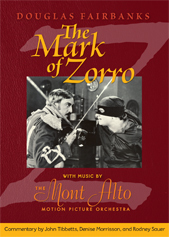
THE MARK OF ZORRO
U.S. 1920, with Douglas Fairbanks, dir. Fred Niblo
Douglas Fairbanks pioneered the double role of Zorro and the foppish Don Diego, combining action and comedy in a delightful romp that established the tradition of the masked superhero. The success of this film changed Fairbanks from a successful light comedian to America’s top action star.
This 1920 silent film, newly transferred from a fine-grain safety print of the original negative, is accompanied by the five-piece Mont Alto Motion Picture Orchestra using historic “photoplay music” to create an authentic, exciting, and compelling score of the kind heard in movie theaters in the 1920s.
Extras include:
An optional commentary track with John Tibbetts, Denise Morrison, and Rodney Sauer
A gallery of John Tibbetts’ Fairbanks artwork
Subtitles identifying the musical pieces used
A short video about “compiled” silent film scores
This is Mont Alto's second self-released DVD in our "Private Reserve" series and is only available directly from Mont Alto. The film and score also appear in the boxed set A Modern Musketeer, in a digitally stabilized version of the same transfer, but without the commentary and extras. Although self-released, it is not a DVD-R; it is a pressed region-free DVD-5. You may purchase copies:
"The Mont Alto Motion Picture Orchestra does an absolutely wonderful job on the score to this film... This score fits the film beautifully, from Don Diego's introduction where the silence of a stranger entering a bar obscured by an umbrella is broken with some frivolous sounding music to the fast-paced songs used for the exciting chase at the end. The music always compliments the action on screen, but never overpowers it or distracts from the visuals. Needless to say, the members of Mont Alto are excellent musicians which makes this score all the more enjoyable to hear....
"This is a great Fairbanks film, full of excitement, comedy, and just the right amount of drama. This charming film is wonderfully accentuated by the Mont Alto Motion Picture Orchestra's score. Though the disc is only available through their web site, it's worth picking up as it's a quality production all the way around. Highly Recommended." --- John Sinnott, DVDTalk.com
"Revisiting this costume drama, one is struck by how thoroughly enjoyable it is from start to finish. Fairbanks and director Fred Niblo expertly combine action, adventure, suspense, and comic relief, with none of the elements overwhelming the others... this is probably the best presentation of this classic to date.
"Most discs that feature Mont Alto scores have excellent recording quality, and this compilation score is no exception. The music is firmly placed in the soundstage, with vivid immediacy. The trumpet in particular comes across beautifully here, though the violin is also frequently striking. No noise or hiss interferes. Although there are a few moments that get a shade repetitive, on the whole the compilation is very effective indeed and supports the action very well; more than once I forgot that I was listening to a score and had become totally absorbed in the film. A wonderful sonic experience that should serve as a model.
"I've previously complained that prior releases of Fairbanks' movies, especially this one, have been released without commentaries or suitable supporting materials. I need complain no more. This disc offers an excellent commentary from author John Tibbets, film festival organizer Denise Morrisson, and Rodney Sauer, who is pianist for the Mont Alto Motion Picture Orchestra and also compiled the score for this version. They have a lively chat that offers plenty of history, details, and thematic and musical analysis without ever becoming dry or pedantic. The threesome obviously love the movie, and it shows.
"...Sauer also hosts a featurette, A Practical Guide to Film Scoring (3m:58s), which gives a look at the process. It's only regrettable in its brevity. A gallery offers a look at various pieces of striking period-style Fairbanks artwork by Tibbetts, and there's a trailer for Mont Alto's release of The General, a similarly excellent release." -- Mark Zimmer, DigitallyObsessed.com.
Here are some audio samples from the DVD score:
Ballet Barbarian, by J.S. Zamecnik, used for a horseback chase through the mountains.
Melancolie, by Rachmaninoff, for scenes of cruel oppression.
THE MARRIAGE CIRCLE
U.S. 1924. dir. Ernst Lubitsch.
This wonderful comedy of misplaced attraction centers around two married couples in Vienna. Professor Stock wants a divorce, and his wife Mizzi wants the excitement of illicit romance. When she decides to seduce her best friend's husband, it livens up all of their lives in ways she doesn't expect. This was a ground-breaking comedy, with humor derived from reactions and adult situations. It shows a refreshing lack of Victorian attidudes on the part of all of the characters -- incidents that would have thrown D.W. Griffith's pure-of-thought virgins into a faint are met here with a wry, knowing smile.
"The score by Rodney Sauer and the Mont Alto Orchestra is delightful in my opinion, and it points the way to visual witticisms I never noticed before. For those to whom comedy is American Pie this will fall flat, but I don't know a film that gets more out of glances, props, reactions, offscreen space, and other such devices of pure movie." --David Shepard
"...the Mont Alto Orchestra offers yet another perfectly-pitched score." -- DVDfile.com
A MODERN MUSKETEER
Boxed Set of Early Douglas Fairbanks Films
Note: Mont Alto's contributions are the score for A Modern Musketeer and The Mark of Zorro.
"...an extraordinary, well-produced set of 10 features and one short film arrives on Tuesday from Flicker Alley. These aren’t the more familiar costume epics from Fairbanks’s later career — several of which have been issued in fine editions by Kino International — but rather the modern-day comedies that first established his screen personality...
"...This pattern reaches one of its high points in “A Modern Musketeer,” a 1917 feature that was one of 11 films Fairbanks made with Allan Dwan, the great master of early film form. Long available only in an incomplete print, the movie was restored in 2006 with footage found by the Danish Film Institute and makes its first appearance on DVD with this set.
"In it Fairbanks plays a Kansas go-getter whose obsession with Alexandre Dumas drives him to ever more preposterous acts of romantic gallantry. In the end he is able to unleash his inner swashbuckler when, during a visit to the Grand Canyon, he is called on to rescue a young woman (Marjorie Daw) from the clutches of an outlaw gang.
"Dwan’s early command of match-cut editing — the apparently seamless presentation of action across a series of shots — is shown off to tremendous advantage here: Fairbanks seems to cut through space like an arrow in flight, a pure line of strength and beauty.
"A Modern Musketeer” begins with a winking prologue in which Fairbanks presents himself in full costume as D’Artagnan, tugging at his false mustache and adjusting his wig to assure his audience that Doug could indeed be found somewhere beneath the shrubbery. Fairbanks was testing the waters for what would be the next development in his career, the transition to period adventure films that began with “The Mark of Zorro” in 1920.
The Flicker Alley set offers “Zorro” in a glisteningly sharp print made from a source close to the camera negative, and the other titles in the box have been mastered with consummate care, even when the source material is not perfect. The movies are presented with period-accurate color tinting and accompanied by appropriate scores performed by some of the leading figures in silent-film music, including Philip Carli, Robert Israel and Rodney Sauer, the leader of the Mont Alto Motion Picture Orchestra." --Dave Kehr, The New York Times
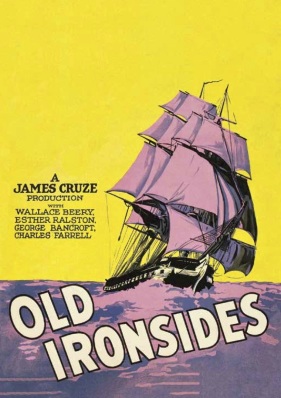
This grand production from Paramount tells the story of the Barbary War, in which America defeated the pirates of the Mediterranean (as the Marines hymn tells, at the "shores of Tripoli." The film starts with a rousing session of congress in Philadelphia, where it is decided to build a navy rather than pay tribute for safe passage.
Charles Farrell and Esther Ralston are the romantic leads, and Wallace Beery and George Bancroft have a ball serving up comic relief as crusty sailors. But the star of the film are the tall ships and the vast naval battle scenes, during one of which a full-sized sailing ship was sunk near the isthmus of Catalina Island.
The score of this edition is Rodney Sauer's piano-solo rendition of the original New York premiere score, part composed (and part compiled) by Hugo Riesenfeld and J.S. Zamecnik, and preserved at the Library of Congress. Like the later score for Wings, It is a fascinating example of the use of "character themes" in early film scores, as themes were composed for the major characters. In those portions of the score that were composed for the film, these themes are woven in and out of the action as the characters appear on the screen (note especially the New England dock scenes and the first squall on shipboard). But in those portions of the score that were compiled from pre-written music, such as the battle sequences, those character themes are of course completely absent.
To the piano score I also added Foley percussion effects, since this film is full of explosions, cannonfire, and other effects that benefit from the involvement of a busy percussionist.
Old Ironsides was originally intended to be shown in "Magnascope," which is a fancy way of saying that the picture was left smaller than necessary but then expanded to the full size of the screen at dramatic points (referred to as "large picture" in the follwing excerpt). The score also called for the film speed to be changed as the film progressed according to the table below (expressed in feet-per-minute, which was the most common gauge on movie projectors of the time). As you'll note, the composers felt that the singing of "Hail Columbia" was filmed too fast, hence the film is slowed down to allow the audience to better sing along.
Kudos to Rodney Sauer, who has beautifully adapted the score from the film’s New York premiere, and performs it on piano. There is nothing more disconcerting than inappropriate music tacked on to a silent film, but Sauer is an expert accompanist and hits all the right notes in support of this feature. His music augments the film perfectly and is among the real highlights of this blu ray release." -- Jim Neibaur's Silent Cinema review site
In a role that established him as one of the most dynamically terrifying performers of the silent screen, Lon Chaney stars in The Penalty, a grotesque thriller from director Wallace Worsley (The Hunchback of Notre Dame).
When an incompetent doctor amputates the legs of a young boy, he has no idea that the youth will grow up to be the immoral and embittered Blizzard, a criminal mastermind who orchestrates a bizarre and heinous plot to avenge himself upon his malefactor. The Penalty teems with irony and sexual menace as Blizzard befriends the surgeon's daughter and serves as an artist's model for her sculptural rendition of Satan, waiting for his moment to show the depth of his demonic desires.
In playing the devious Blizzard, Chaney tightly harnessed his legs within a pair of leather stumps, flawlessly rendering the physical disfigurement that so profoundly echoes the misshapen mind that drives this sadistic character toward his violent destiny. As Chaney biographer Michael Blake says, "One has to wonder if the intensity Lon brought to this role might have been due in part to the pain produced by his harness."
"The accompanying music score compiled by Rodney Sauer and performed by the Mont Alto Motion Picture Orchestra is excellent and a vast improvement over the synthesizer score of the Kino DVD edition noted below. The score is appropriate to the film’s action, mood-settting, entertaining and historically respectful of the film. The music is well-recorded and excellent listening in both surround and stereo sound."
"The audio on 'The Penalty' comes in two flavors, The Mont Alto Orchestra DTS-HD Master Audio 5.1 and The Mont Alto Orchestra 2.0 LPCM. For the purpose of this review, the DTS-HD track was chosen and it certainly doesn't disappoint. A subtly layered effort, the new musical mix envelops the listener with a sound quality that belies the age of the film – but in only the best possible way. While most of the orchestral sound and piano elements are pushed through the front channels, the lossless track will occasionally send certain elements through to the rear channels for added effect. The result is astonishing musical clarity that accompanies the onscreen images and action quite well."
People on Sunday (Menschen am Sonntag) represents an astonishing confluence of talent—an early collaboration by a group of German filmmakers who would all go on to become major Hollywood players, including eventual noir masters Robert Siodmak (The Killers, Criss Cross) and Edgar G. Ulmer (Detour, Bluebeard) and future Oscar winners Billy Wilder (Sunset Boulevard, Ace in the Hole) and Fred Zinneman (High Noon, A Man for All Seasons). This effervescent, sunlit silent film, about a handful of city dwellers enjoying a weekend outing (a charming cast of nonprofessionals), offers a rare glimpse of Weimar-era Berlin. A unique hybrid of documentary and fictional storytelling, People on Sunday was both an experiment and a mainstream hit that would influence generations of film artists around the world.
"...the movie captures the vicissitudes of courtship with time-lapse acuity: the switched allegiances (Wolfgang, you cad!), the nervous etiquette (Christl and Wolf shake hands three separate times at the end of their first meeting), the seismographic spikes and plunges of moment-to-moment attraction. People on Sunday is timelessly perceptive about the intermingling of lust, hostility, and boredom that happens when a romantic chemical equation has some trouble finding its balance." -- Jessica Winter, Believer Magazine
"It really can't be emphasized enough how much of a delight it is to watch People on Sunday. The mood is buoyant, but laced with a hint of underlying cynicism, the camerawork graceful and accomplished, the performances unassuming. It's an auspicious, if ultimately atypical, work from a collaborative group of future filmmaking stars... People on Sunday certainly sounds interesting from an academic standpoint, but it's also a totally enchanting film experience—a quality that will likely catch a number of viewers by surprise." -- Dusty Somers, Blog Critics
"There are two choices of scores, the first is a sort of generic orchestration that was typical of the era, and an original modern version composed by Elena Kats-Chernin. Both alternatives are fairly recent recordings and are offered in stereo. Much to my surprise, I preferred the breezy, bluesy qualities of the first [Mont Alto] track. The Kats-Chernin chart was excessively busy and overly cued for my taste - with brief segments reminiscent of Phillip Glass at his most hyper - and ultimately more distracting than supportive." -- IonCinema
"Each of the disc's two scores is presented as a bright and clear uncompressed PCM soundtrack. The first--and the one that the disc, I think rightly, defaults to--is the most recent, composed and performed by the Mont Alto Orchestra live for the film's showing at the 2009 Telluride Film Festival, and now recorded especially for Criterion's release. This score is closer in tempo and melody to what one more readily associates with the musical accompaniment for a silent film. The second soundtrack is a score conceived and performed by the Czech Film Orchestra in 2000; it is notably slower and more contemplative, and using the audio key on my remote to alternate from one soundtrack to the next reminded me of just how powerful an ingredient film music is, as the Mont Alto soundtrack makes many scenes feel lighter, more buoyant and carefree; whereas the Czech Film Orchestra soundtrack (which even includes some operatic vocals) adds a somewhat weightier, more tender aspect to some of the same scenes. As usual for Criterion, this is an embarrassment of riches; over time, it would not seem at all unreasonable to give each of the scores at least one go." -- Christopher McQuain, DVDTalk.com
This collection of early films includes the 1914 film The Italian, the 1913 Traffic in Souls, and three Edison short features: Police Force, New York City (1910), McQuade of the Traffic Squad (1915), and The Call of the City (1915). The Italian is about the experiences of Beppo, who emigrates to New York City in order to earn enough money to please his fiancee's father.
"With excellent musical accompaniment by Rodney Sauer’s Mont Alto Motion Picture Orchestra (for The Italian) and the pianist Philip Carli (for Traffic in Souls), this is one of the summer’s most outstanding releases." --Dave Kehr, The New York Times.
"The Italian has a score compiled and performed by the Mont Alto Motion Picture Orchestra who, as usual, are wonderful. The score was complied from music of the time which gives the movie an old-time feel, and is also scene specific. Mont Alto are my favorite silent film orchestra and it's hard to rave about them without repeating what I've said in other reviews. Suffice to say that I have yet to hear a score of theirs that wasn't excellent." -- DVDTalk.com.
"The score for The Italian is provided by the Mont Alto Motion Picture Orchestra; the compilation score is quite effective in support without being obtrusive. The recording quality is expectional, with a vividness and a sense of presence that is duplicated on few other discs. It truly feels like having the Mont Alto right there in your living room, with excellent depth and resonance." --DigitallyObsessed.com
"The Italian is greatly aided by a fine score from Rodney Sauer which helps to enhance the mood generated by this rather downbeat film." -- Chip Kaufmann, at amazon.com
SHERLOCK JR. / The Three Ages
(Buster Keaton, 1924).
In one of Buster Keaton's most impressive comedies, he plays a small-town movie projectionist who dreams of becoming a detective. When his attempts at solving a crime fail miserably, he goes back to his job and has a dream where he climbs into the movie he's showing and becomes a super-sleuth. Sherlock Jr. is 45 minutes filled with inventive stunts, comedy, and a parody of James Bond long before James Bond was ever dreamed up. The film is provided with two alternate scores as well -- one by the Clubfoot Orchestra, and one compiled from historic jazz recordings by Jay Ward.
Also on the disc is Keaton's first feature "The Three Ages," also with three alternate scores, though none by Mont Alto.
"Nearly 90 years (wow) after their original release, these Buster Keaton comedies maintain much of their original charm and hilarity. Kino's preservation efforts also remain admirable and (for the most part) successful. This double feature is a tad lop-sided; for all of its virtues, Three Ages simply can't measure up to the absolute delight that is Sherlock Jr. Then again, few movies can.
"We sampled all [of the scores], but mostly stuck with the Mont Alto 5.1 track, which is lush, well-distributed, and nicely matched to the action." -- DVD Talk.com
STRIKE
Russia 1924, Sergei Eisenstein
The first feature film by the director of Battleship Potemkin, Sergei Eisenstein's STRIKE is a visual tour-de-force that employs dynamic editing and experimental camerawork to dramatize the saga of a bitterly-fought factory strike in 1903. Often compared to Citizen Kane in terms of audacious directorial debuts, STRIKE embodies the revolutionary spirit of the Soviet people of the 1920s, cresting the waves of artistic and political idealism.
This edition of STRIKE was mastered in HD from a 35mm film element restored by the Cinémathèque de Toulouse, with a newly-recorded score by the Mont Alto Motion Picture Orchestra, adapted largely from the works of traditional Russian composers.
"This edition has been transferred in high-definition from the 35mm restored version by La Cinémathèque de Toulouse. As would be expected from older print materials, there is a noticable amount of film grain that is fully reproduced in HD here. However, the edition is quite pleasing with its high-definition transfer that well-balanced but a little dark across the grayscale range, nonetheless holding open shadow areas in the picture that were previously plugged-up in older video transfers. A few shots are distractingly jittery, with the picture jumping about in the frame. We wish that picture stabilization had been performed on the preservation materials or on the video transfer. The edition is presented with new video-based English language intertitles.
"Excellent musical accompaniment has been arranged from traditional Russian music by Rodney Sauer and performed by the Mont Alto Motion Picture Orchestra. The music conveys proper mood throughout the presentation and significantly adds to the enjoyment of the film.
"We highly recommend this Blu-ray Disc edition of Sergei Eisenstein’s Strike, which has never looked as good on home video as it does here." -- Carl Bennett, silentera.com.
Here are two excerpts from the score:
Hungarian Dance, by A. Glazunow, for a scene featuring a picnic with a man playing accordion
Gitanella, by P. Lacome, an orchestral work with a bit of gypsy flair.
To purchase, we recommend visiting the Kino website directly.
SUDS
U.S. 1920, Mary Pickford
Mary Pickford plays laundry-girl Amanda Afflick. Stuck in a hopeless job, she builds a fantasy life around a mysterious customer who left a shirt at the laundry, and who she comes to believe will return for the shirt -- and for her. Despite some lovely comic sequences involving caring for a horse in her upstairs apartment, and her fantasy of how she fell from being the daughter of a duke to be a laundry drudge, Mary wanted it to end with Amanda being left alone, her dreams dissolved. When audiences reacted badly to this tragic, Chaplinesque ending, Mary filmed several "happy" endings -- two of which appear on this disc.
This DVD contains two complete versions of the film. The print used in foreign releases was composed completely of different takes from the print released in the U.S. The American print has a score by the Mont Alto Motion Picture Orchestra, while the European release has a score by the organist Gaylord Carter.
"This movie comes with a stereo score that was arranged and performed by the Mont Alto Orchestra. The audio was very good, sounding clean and clear and creating a nice atmosphere for the film. I really enjoy orchestral tracks, even from a small five piece group like Mont Alto. They just seem to breathe life into silent films and make them more enjoyable to watch.
"This audio track did a good job of complimenting the action on screen. They managed to accent the drama without becoming over bearing like many scores in current movies do. A good example of this is when Amanda comes to a bitter realization at the end of the film. Instead of having the string section swell up with sad music (if I have to listen to that one more time I think I’ll scream) they have a clarinet come to the forefront, followed by a violin and piano. They followed the mood of the scene instead of trying to take the lead. A very fine score, especially when you compare it to Gaylord Carter’s organ soundtrack to the foreign release cut of the film."
--DVDTalk.com
THE THIEF OF BAGDAD
U.S. 1924, Douglas Fairbanks.
Mont Alto has compiled and recorded a score based loosely on the original cue sheet by James Bradford.
A spectacular accomplishment in production design and special effects, Raoul Walsh's THE THIEF OF BAGDAD is a bold Arabian adventure starring Douglas Fairbanks as a carefree pickpocket who turns his appealing brand of mischievous thievery toward the attainment of happiness... and an exotic Princess (Julanne Johnston). The only way he can win either is by retrieving the rarest treasures hidden within the mysterious Orient, a quest that grows more fantastic with every passing thrill, as the tenacious thief rises high above the city on a magic carpet, battles a fire-breathing dragon in caverns of flame and soars into the clouds on the back of a winged steed via innovative special effects.
This special Kino on Video DVD is the definitive edition of Fairbanks’s classic, digitally mastered from a 35mm archive negative, with 19 minutes of rare outtakes and special effects footage.
Review from DVDTalk.com
"...The sound track is provided by the Mont Alto Motion Picture Orchestra based on the original 1924 cue sheets. Mont Alto has been around for around for about ten years specializing in live accompaniments to silent movies. This is the tenth movie that they have recorded a music track for. Though I have heard of them before, this is disc is the first time I have heard their music. I was very impressed. The score worked very well, accenting the mood, and complimenting the action, but never becoming intrusive. This five piece ensemble’s thoughtful arrangement added another dimension to the picture. I can only hope that they crop up on more DVDs in the future. The sound quality was very good. The stereo mix sounded full and clear. There was no hiss or tape noise that sometime accompanies older soundtracks. One of the best sounding silent era DVDs I have had the pleasure to screen.
...A very impressive looking disc, one of the best silent era DVDs I’ve seen.... The musical score added a lot to the film, illustrating how important the musical selection can be. All this is on top of an excellent movie that is full of spectacle and grandeur. A delightful romp through a Bagdad that never existed, but we all wish did. If only all silent era DVDs could live up to the high standards set by this disc. "
"The exception, again, is The Thief Of Bagdad, an all-around winner. Its lavish and evocative orchestral score matches Raoul Walsh's vigorous direction and the eye-poppingly inventive matte effects, which pack nearly every frame with incidental wonder."
-- The Onion
Listen to the Opening Title music for the Thief of Bagdad -- a medley of Azora: Prelude to Act III (Henry Hadley) and Priere Hindoue (Irenee Berge).
Listen to Orientale, by Nicolas Amani, the music we use for the scene at the giant statues of Kandahar.
TRUE HEART SUSIE / HOODOO ANN dir. D.W. Griffith U.S. 1919 / 1916. 86 min.
In 1918-1919, D. W. Griffith turned from spectacles such as The Birth of a Nation, Intolerance, and Hearts of the World to smaller films, which he called his "short story series." Among these is True Heart Susie. "There are those of us who consider True Heart Susie to be Griffith's masterpiece," writes Tom Gunning in his notes for a 2006 screening at the Pordenone Silent Film Festival. He goes on to praise the "narrative structure and point of view, as well as the fine details of performance, framing, and even the use of intertitles that makes a seemingly modest film such as this appear nearly incandescent in its confessional and emotional power." In an almost mythical American arcadia, Lillian Gish portrays a pure, prim girl who so loves her childhood sweetheart (Griffith's most charming boyish hero, Robert Harron) that she sells the family cow to anonymously finance his higher education, only to lose him to a more "modern" woman (Clarine Seymour) when he comes home. Gish's performance is among her best, her face what Gunning calls a "battleground of emotions, staging complete and progressive dramas of realization, recognition and despair."
As a bonus feature we offer Hoodoo Ann. This light comedy is Griffith-supervised and scripted (using the pseudonym Granville Warwick), although the actual direction is by Lloyd Ingraham. Mae Marsh is paired with Robert Harron; the actors had been often partnered since Biograph days, concurrently were in the modern story of Intolerance and continued to play leads together until Miss Marsh left the company at the end of 1916. Although the plot is a tangle of unlikely coincidence, the performers make it work, and "it is filled with those little touches for which Fine Arts pictures are famous," in the words of an original review.
"... a new score, performed by the Mont Alto Motion Picture Orchestra, ... perfectly captures the film’s knowing naïveté." -- David Kehr, The New York Times. (See complete review).
"The score for the feature film was performed by the Mont Alto Motion Picture Orchestra from a score compiled by the group's pianist, Rodney Sauer. They do their usual excellent job, both musically and having the music fit the tone of the movie. Hoodoo Ann is presented with a piano score that Mr. Sauer compiled and plays. This too was very good and the solo piano fit the simple feeling of the movie. Mr. Sauer also realizes that less can be more and in some scenes has very minimal music. The section where Ann breaks a doll that she's 'borrowed' is like that, and the lack of energetic playing accented the scene well. Since these are recent recordings there are no audio defects. The sound is strong and clear." -- John Sinnott, dvdtalk.com.
"The presentation is buoyed by a pleasant small-orchestra music score compiled from contemporary theatrical sheet music by Rodney Sauer and performed by the Mont Alto Motion Picture Orchestra, one of the best practioners of silent film accompaniment." -- Carl Bennett, silentera.com.
LES VAMPIRES
dir. Louis Feuillade, 1915-1916. 6.5 hours.
The undisputed master of the espionage serial, Louis Feuillade (Fantômas) crafted films with labyrinthine plots and unforgettable characters that influenced multiple generations of filmmakers. Comprised of ten episodes, and clocking in at nearly seven hours in duration, Les Vampires is an unqualified masterpiece. It follows journalist Philippe Guérande (Édouard Mathé) in his efforts to expose a vast criminal organization known as the Vampires. Joined by a comical sidekick, Mazamette (Marcel Lévesque), and often competing against a rival gang lord (Fernand Herrmann), Guérande dethrones a succession of the Vampires' Grand Masters. But most evasive of all is the Vampires' muse, a seductive assassin who performs her job with deadly grace: Irma Vep (Musidora).
Authorized by the Gaumont Studios, this edition was mastered in HD from the 35mm restoration produced in 1996 by the Cinémathèque Française, under the supervision of Feuillade's grandson, Jacques Champreux.
"This presentation is accompanied by a wonderful music score by the Mont Alto Motion Picture Orchestra. Well arranged and performed, the music adds texture and pacing to this atmospheric thriller. We now prefer this music score and performance to others for Les Vampires released on home video." -- Carl Bennett, Silent Era
"Though obviously a silent film and thus not needing a soundtrack restoration, Les Vampires is presented with a stunning – and I mean stunning – score by the Mont Alto Picture Orchestra. They’ve crafted a very definite, iconic theme to accompany the film that recurs often, though not so much as to feel this was merely put on a loop. Scene-specific scoring, as with a rousing party or a particular moment of suspense, feels perfectly attuned to the film. They do throw in a few instrumental sound effects, like a clock ticking or a doorbell buzzing, but anyone who’s seen a silent film with orchestral accompaniment can attest this is a fairly common practice, one almost inherent to the form. Anyway, it is wonderful, and I’ve been humming the theme for days." -- Scott Nye, Battleship Pretension
Here is the complete recording of Fourteen Fathoms Deep: An Undersea Tragedy, by M.L. Lake. This is the "Main Theme" that I selected for the serial, particularly because it starts with a distinctive four-note musical phrase that I could quote whenever the Vampires do something nasty or surprising. I also recorded those four notes on each solo instrument in the Mont Alto quintet, so that I could vary the statement depending on the mood of the scene. After that introduction, the piece has six repeated sections, many of which quote that four-note theme. By using different sections at different points in the seven-hour score, I could avoid over-using the main theme, while still giving the score some cohesiveness.
Here's a recording of Danse Exotique, by Wilson Smith, from the score. This comes from Smith's suite "At the Bal Masque."
NOTE: Many of the reviews on the amazon.com are for previous video releases of Way Down East, so comments about the edition may not apply.
WAY DOWN EAST
dir. D.W. Griffith U.S. 1920. 149 min.
In what may have been his most brilliant surprise, D.W. Griffith transformed an archaic melodrama about a wronged woman into a transcendent love story of redemption. Lillian Gish plays an innocent New Englander seduced by an urbane charmer (Lowell Sherman), who arranges a mock marriage and then abandons her when she's pregnant. When the baby dies from illness, Gish leaves the city and changes her identity. She finds herself reborn in the pastoral splendor of a farming community, catching the adoring eye of a young idealist (Richard Barthelmess), only to have the past come back to haunt her. Griffith made two kinds of films: spectacles and love stories. It's the tremulous love stories such as Way Down East that have endured the best. This 1920 film is a triumph of humanity over cruelty, a work that brilliantly conveys emotion through environment. The famous climax on the floating river of ice is still amazing--especially since it uses no special effects. --Bill Desowitz
"We also appreciate the delicate score, newly arranged and utilizing everything from vintage parlor music to a little Sibelius, and played by The Mont Alto Picture Orchestra, a five- to seven-piece chamber ensemble. As a special feature, Mont Alto's leader, Rodney Sauer, details his approach to configuring such a massive outlay of continuous music, which, nicely captured in 2.0 stereo, is a welcome relief from the Vitaphone track (used in a 1928 reissue of the film) imposed on our ears by the David Shepard Image edition." --Gordon Thomas, Bright Lights Film Journal.
Listen to J.S. Zamecnik's piece Atonement--the "true love" theme--from the score.
Listen to Gaston Borch's piece Mountain Song--the "deceptive love" theme--from the score.
THE WHISPERING CHORUS
dir. Cecil B. DeMille U.S. 1918. 86 min.
Cecil B. DeMille wanted to create a psychological film that went beyond stock melodrama characters to investigate the psyche of average, flawed people. What resulted was this amazing dark thriller, without one heroic figure. As each acts to serve his or her own interest, the situation spirals out of control. The "whispering chorus" of the title refers to the little voices we hear in our heads that give us advice -- for good or ill -- which DeMille conveys on the screen by means of well-executed special effects. Raymond Hatton plays the ill-fated John Tremble, whose attempt to flee a crime and change his identity leads to his arrest for killing... himself. Kathlyn Williams plays his wife, who recognizes him but decides not to save him in order to preserve her own life of comfort.
The Whispering Chorus was released along with Old Wives for New on the Image Entertainment label.
"This was a very good film. The narrative is quite unlike DeMille's more commercial romantic comedies, both in style and substance. This psychological drama had a lot of atmosphere that made the film more intense, and the effects really added to the drama. The superimposition used to illustrate the voices in Trimble's head worked very well, and the tinting, based on the original prints, also served to set the mood. A very fine piece of work. I'm surprised that this film wasn't the one that received top billing on this DVD...
"...I much preferred the soundtrack to The Whispering Chorus by the Mont Alto Orchestra. This small group does a great job. The score was compiled by leader Rodney Sauer from contemporary music and fits the movie well. I always enjoy Mont Alto's work, and this score is no exception."
WHY CHANGE YOUR WIFE? with MISS LULU BETT
dir. Cecil B. DeMille, U.S. 1920
"At a time, in the teens and early 20's, when divorce was becoming increasingly common but still considered scandalous, DeMille took it as the subject of a series of films. Two, Don't Change Your Husband (1919) and Why Change Your Wife? (1920), have recently been released in fine, tinted versions with excellent scores by the Mont Alto Motion Picture Orchestra.
"Both feature DeMille's first muse, Gloria Swanson (who 30 years later in "Sunset Boulevard" would finally advise him that she was ready for her close-up). In "Don't Change Your Husband," she's a jazz baby married to a boorish businessman (Elliott Dexter) and leaves him for a society fop (Lew Cody). "Why Change Your Wife?" reverses the roles, with Swanson as a housebound prude whose husband (the major silent era star Thomas Meighan) leaves her to marry a flapper (Bebe Daniels).
"The films are early examples of the subgenre the philosopher Stanley Cavell called "the comedy of remarriage." DeMille, as he did in his biblical spectacles, shrewdly manages to have things both ways, suggesting that there's nothing like a good divorce to teach you to understand and appreciate your spouse.
"Husband is the more extravagantly entertaining of the two, replete with the lavish historical flashbacks and wild party scenes that were becoming DeMille's trademark. But the more restrained Wife has its pleasures as well, as when Swanson steps out for a flapper makeover that leaves her looking like a spider with a cocaine dependency."
--Dave Kehr, The New York Times
"The Mont Alto Motion Picture Orchestra (led by Rodney Sauer) can always be counted upon to provide flavorful and historically accurate scores for silent film, and this DVD is no exception. When Mr. and Mrs. Gordon disagree over their musical tastes alongside the Victrola, it becomes an opportunity for Mont Alto to provide a playful added layer of comedy and meaning to the film. Their concisely orchestrated arrangements make Why Change Your Wife (and its co-feature) an aurally rich viewing experience."
-- Asa Kendall Jr., Turner Classic Movies (www.tcm.com)
Both of these films are accompanied by the Mont Alto Orchestra and they do a wonderful job, as always. This five piece group compiles their own scores from music of the time giving the films an authentic feel. The music is scene specific, of course, and played with much precision. This music really brings the films to life and adds a lot to the enjoyment of the film. (I especially liked the way they matched the child playing the piano in Miss Lulu Bett. The music itself made me laugh.)
The waltz "Persian Princess" from the score to Why Change Your Wife.
THE WISHING RING
U.S. 1914, dir. Maurice Tourneur.
The Image DVD "Before Hollywood, There Was Fort Lee, N.J." features several short films scored by different musical ensembles. Mont Alto contributed the score to the longest feature on the DVD: Maurice Tourneur's The Wishing Ring.
"The film which makes this DVD worthwhile is The Wishing Ring (1914). Directed by the great Maurice Tourneur, it is set in early 19th century England, telling the story of the son of an earl who after getting himself kicked out of school and falling out with his father, finds himself working as a lowly gardener. Here he meets and falls in love with the parson's daughter. This is an accomplished film, sweet and romantic, with good acting and production values. The tinted print is very good, clear and sharp with hardly any damage. The Mont Alto Orchestra score is full of tunes associated with England. The score and the playing of Mont Alto really fits the action. At times they even deliberately play excruciatingly badly when, for instance, the action includes a character who can't play the piano. This musical effect is well done and makes for an unusual experiment, which for the most part works very well."
Mr. Peter G. George, on amazon.com.
"The end result is absolutely enchanting and I feel we can share real pride at bringing this forgotten film back to glowing life.... Beyond the lovely music I thought the donkey and dog effects and the deliberately awful intoxication and hymn music were in complete accord with the tongue-in-cheek spirit of the whole thing. A big tip of the hat. It's BEAUTIFUL."
David Shepard's comments on delivery of the final score
Listen to Herbert Haines composition "A Simple Love Episode" from Mont Alto's The Wishing Ring score